Why Bone Density (Not Just Muscle) Is a Longevity Metric Worth Tracking
Quick Answer: Bone density peaks around age 30 and declines gradually afterward, with the rate accelerating sharply for women after menopause. Weight-bearing and resistance exercise — particularly movements that load the spine and hips directly, like squats and deadlifts — are among the few interventions shown to meaningfully slow that decline.
Muscle mass gets most of the longevity spotlight, but the skeleton holding that muscle up is just as fragile a system, and it fails quietly, with no symptoms, until a fall turns a minor accident into a life-altering injury.

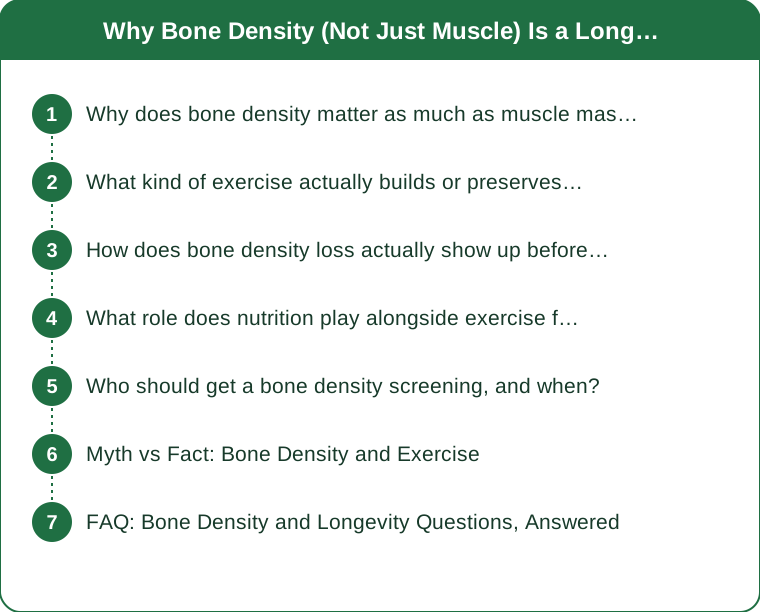
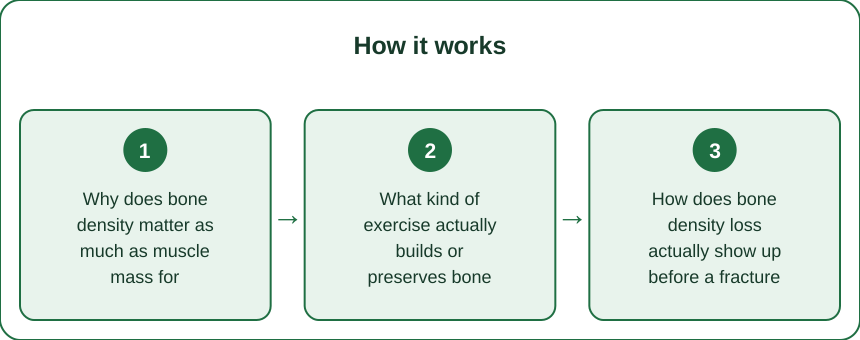
Why does bone density matter as much as muscle mass for long-term health?
Bone and muscle decline are deeply linked, but they’re not the same system, and bone loss is far less visible day-to-day. Peak bone mass is typically reached around age 30, after which density gradually declines — and for women, that decline accelerates substantially in the years around and after menopause as estrogen, which helps regulate bone remodeling, drops.
The real-world consequence shows up later: a hip fracture in someone over 65 carries a genuinely serious risk profile, including a meaningfully elevated risk of death within the following year, largely due to complications from reduced mobility and hospitalization rather than the fracture itself. That’s a much higher stakes outcome than most people associate with ‘thin bones,’ which is part of why bone density deserves its own place in a longevity conversation, separate from muscle.
What kind of exercise actually builds or preserves bone density?
Weight-bearing and resistance exercise are the two categories with the strongest evidence, and for a specific mechanical reason: bone responds to mechanical loading by remodeling itself to be stronger where the stress is applied. Activities like walking provide some benefit, but higher-impact and resistance-loaded movement produces a stronger stimulus than low-impact cardio alone.
Compound resistance movements — squats, deadlifts, step-ups, and loaded carries — are particularly effective because they load the hip and spine directly, which happen to be the two most common and consequential fracture sites. General guidance from bone health research points toward resistance training at least twice a week, progressively increasing load over time, as a reasonable target for most adults without a contraindicating condition.
Impact activities like jumping drills or stair climbing add an additional stimulus beyond pure resistance training, though anyone with existing joint issues or diagnosed low bone density should get individualized guidance before adding higher-impact work.
How does bone density loss actually show up before a fracture happens?
This is the uncomfortable part: bone density loss is essentially silent. There’s no day-to-day sensation of bones getting weaker the way there might be a felt sense of muscle loss or reduced stamina. Most people find out through a DEXA scan (a specific low-radiation bone density scan) ordered by a doctor, often prompted by age, family history, or an early fracture from a minor fall.
This silence is exactly why bone density deserves proactive attention rather than reactive attention — by the time a fragility fracture happens (a break from a fall that wouldn’t normally cause injury, like tripping on a curb), a meaningful amount of bone density has typically already been lost. Waiting for a symptom before addressing bone health means waiting for the outcome you were trying to prevent.

What role does nutrition play alongside exercise for bone density?
Calcium and vitamin D are the two nutrients most directly tied to bone health, since calcium is a primary structural component of bone and vitamin D governs how well the body absorbs it. General guidance for most adults lands around 1,000-1,200 mg of calcium daily and 600-800 IU of vitamin D, though individual needs vary and a doctor can check actual vitamin D levels through a simple blood test rather than guessing.
Protein intake also matters more than commonly assumed — adequate protein supports the collagen matrix that gives bone its flexibility alongside its mineral hardness, and chronically low protein intake has been associated with weaker bone outcomes in some research. Exercise and nutrition work together here rather than substituting for each other: mechanical loading provides the stimulus, and adequate nutrients provide the raw material to respond to it.
Who should get a bone density screening, and when?
General guidance points to women starting around age 65, or earlier if risk factors are present — a family history of osteoporosis, early menopause, long-term steroid medication use, a smaller body frame, or a previous fragility fracture. Men are typically screened somewhat later unless similar risk factors apply, since bone loss tends to accelerate later and more gradually for men without the sharp estrogen-related drop women experience at menopause.
A DEXA scan is quick, low-radiation, and produces a T-score that compares your bone density to a healthy young adult reference — this is the actual diagnostic tool for osteoporosis and osteopenia (an earlier, milder stage of bone loss), rather than symptoms or guesswork. Anyone with a fracture from a low-impact fall at any age is generally considered a candidate for screening regardless of age.
Myth vs Fact: Bone Density and Exercise
Myth: Walking alone is enough to maintain bone density as you age. Fact: Walking offers modest benefit, but resistance training and higher-impact loading produce a substantially stronger stimulus for bone, particularly at the hip and spine.
Myth: Bone density loss is an inevitable, unmodifiable part of aging. Fact: The rate of decline is heavily influenced by modifiable factors — resistance exercise, calcium and vitamin D status, and protein intake all measurably affect the trajectory.
Myth: Bone density only matters for older women. Fact: Peak bone mass is built by around age 30 for everyone, and lifelong loading habits (or their absence) in your 20s and 30s directly affect how much density there is left to lose later.
FAQ: Bone Density and Longevity Questions, Answered
Can bone density actually improve once it’s already declined, or only be maintained?
Research shows resistance training and adequate nutrition can produce modest measurable improvements in bone density even after decline has started, particularly at sites directly loaded by the exercise, though results vary by individual and by how much loss has already occurred.
Is running good or bad for bone density?
Running is a weight-bearing, moderate-impact activity that offers real bone benefit, particularly compared to non-impact cardio like swimming or cycling, though it’s generally best paired with resistance training rather than relied on alone for comprehensive bone loading.
How long does it take to see a measurable change in bone density from training?
Bone remodels much more slowly than muscle — meaningful density changes on a follow-up scan typically take a year or more of consistent training, which is part of why this needs to be a long-term habit rather than a short program.
TL;DR:
- Bone density peaks around age 30, then declines gradually — faster for women after menopause
- Resistance training (squats, deadlifts, loaded carries) 2x/week+ is one of the strongest modifiable levers
- Bone loss has no symptoms until a fracture happens, so screening matters more than waiting to feel something
- Calcium (1,000-1,200mg), vitamin D, and adequate protein support the training stimulus
This is general information, not medical advice — talk to a doctor about bone density screening, especially with any personal or family history of fractures or osteoporosis.
Keep Reading
This article is for general informational purposes only and is not medical advice. Always consult a qualified health professional for guidance specific to you.