Why Your Fifties Decide How Your Eighties Go
Quick Answer: Your fifties are the decade where the rate of decline gets set rather than the decade where decline is felt. Muscle mass, bone density, VO2 max and balance all begin dropping measurably faster after about 50, but the losses are small enough that nothing feels wrong — so most people do nothing, and arrive in their seventies having lost 20 to 30 percent of a capacity they could have largely kept. Strength training two to three times a week is the single intervention with the broadest effect on that slope.
Nothing dramatic happens in your fifties. That is precisely the problem.
You are not slower in a way you notice. You are not weaker in a way that stops you doing anything. The numbers are moving, though, and by the time the change is obvious enough to act on, you are working against a much steeper hill than the one you were standing on at 52.

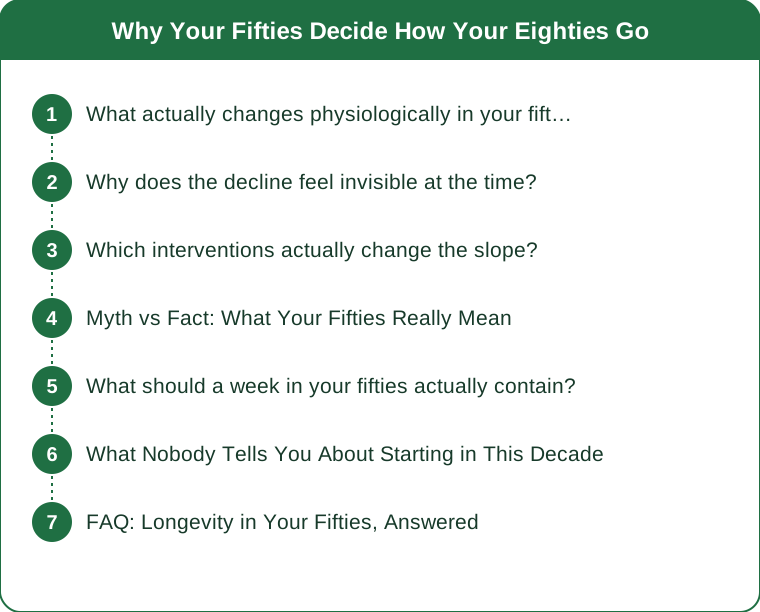
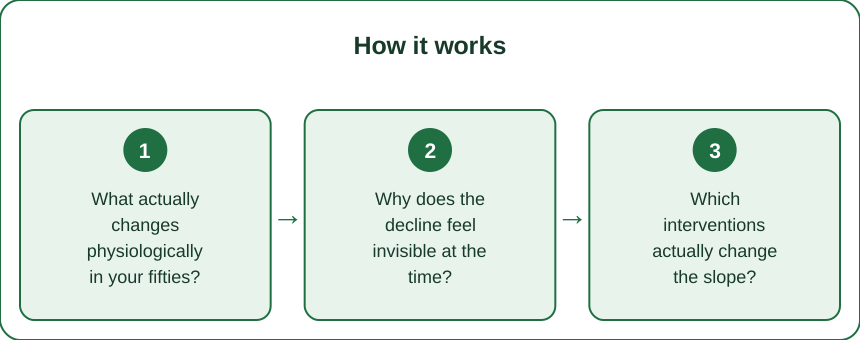
What actually changes physiologically in your fifties?
Four systems begin declining at a rate that is measurably faster than the decade before, and they decline together rather than in sequence.
Muscle mass. After around 50, the rate of loss roughly doubles compared with the forties. The commonly cited figure is one to two percent per year, but the more important number is strength, which falls faster than mass — around two to four percent per year in untrained adults. That gap exists because you lose the largest, fastest motor units first, and those contribute disproportionately to force production. Losing them is why the change shows up in stairs and in getting up off the floor long before it shows up in the mirror.
Bone density. For women, the sharpest drop occurs in the years surrounding menopause, and it is genuinely steep — bone loss can run at two to three percent per year for several years around that transition before settling back to a slower baseline. That window is not a slow drift; it is the single fastest structural change most bodies undergo in adulthood, and it happens without symptoms.
Aerobic capacity. VO2 max declines by roughly ten percent per decade in sedentary adults, and the decline steepens after 50. Because everyday activity rarely approaches your ceiling, you can lose a substantial slice of your aerobic reserve without noticing anything at all in normal life. The first signal is usually a hill, a flight of stairs with luggage, or a grandchild.
Balance and reaction time. Postural control depends on vision, the vestibular system, and proprioception, and all three degrade slowly from midlife. This is the least glamorous item on the list and arguably the one with the largest consequence, because it is the direct input to fall risk.
Why does the decline feel invisible at the time?
Because your daily life demands a small fraction of your capacity, and that fraction keeps shrinking to match.
Think of physical capacity as a ceiling and daily demand as a floor. At 30, the gap between them is enormous. Nothing you do in a normal week comes close to your maximum, so a ten percent reduction in the ceiling changes nothing you can perceive.
By your fifties, the ceiling has come down and the floor has often come down too — you drive rather than walk, you take the lift, you carry less. The gap can stay comfortable even as the ceiling falls, which is exactly why the loss is invisible. You are not testing yourself, so you cannot detect the change.
Then somewhere in your seventies, the ceiling meets the floor. A task that was trivial — a flight of stairs, a suitcase into an overhead locker, standing up from a low sofa without hands — becomes a task that requires most of what you have. Nothing changed suddenly. The lines simply crossed.
The practical implication is uncomfortable: you cannot use how you feel as your instrument in this decade. Feeling fine is compatible with losing a percent of your strength every year. You need measurements, and the useful ones are simple — how much you can carry, how fast you can climb, how long you can stand on one leg, how quickly your heart rate comes down after effort.
Which interventions actually change the slope?
Resistance training changes it most, and nothing else comes close for breadth of effect.
Resistance training two to three times per week addresses muscle mass, strength, bone density, glucose handling, and balance simultaneously. No other single intervention touches that many systems. The dose that matters in the research is not extreme — two sessions a week covering the major movement patterns, taken close enough to failure to be genuinely hard, produces most of the available benefit. Adults in their sixties, seventies and eighties respond to it. Starting late works; not starting does not.
Loading matters for bone, and only loading does. Bone responds to strain, which means meaningful weight or impact. Walking, valuable as it is for many other reasons, does not provide enough strain to drive bone adaptation in a body already accustomed to walking. Resistance work and, where joints permit, some impact are what shift the bone conversation.
Aerobic work protects the ceiling that everything sits under. VO2 max is one of the strongest predictors of all-cause mortality in the literature, stronger than most conventional risk factors, and it responds well into old age. A mix of easy volume and a small amount of genuinely hard interval work is more effective than either alone.
Protein intake becomes limiting. Older muscle is less sensitive to protein — the same dose triggers a smaller building response than it did at 30. The practical adjustment is more protein per meal rather than more in total, spread across the day rather than concentrated at dinner.
Balance is trainable and almost nobody trains it. Single-leg standing, a few minutes several times a week, measurably improves postural control. It costs nothing, requires no equipment, and addresses the risk with the worst consequences.

Myth vs Fact: What Your Fifties Really Mean
Myth: Decline in your fifties is hormonal and therefore not modifiable. Fact: Hormonal change is real and does affect the rate, particularly for bone in the years around menopause. It sets the background rate; it does not determine the outcome. Trained adults in their fifties routinely have more muscle and better aerobic capacity than untrained adults twenty years younger, which would be impossible if hormones were the whole story.
Myth: It is too late to build muscle after 50. Fact: It is not. Hypertrophy is slower and requires more consistency, but the capacity to gain strength is retained deep into old age. Studies in adults in their eighties and nineties show meaningful strength gains from resistance training. The window does not close; it narrows.
Myth: Walking is enough. Fact: Walking is genuinely excellent for cardiovascular health, mood, and general activity levels, and you should do it. It is not sufficient stimulus for muscle or bone in someone whose body already regards walking as normal. Two things are needed, and most people are doing one.
Myth: If you were athletic when you were young, you have a buffer. Fact: You have a slightly higher starting point and better movement skill, both of which help. You do not have stored fitness. Muscle built at 25 and lost by 55 is gone; the advantage of past training is how quickly you can rebuild, not what remains.
Myth: The goal is to slow the decline. Fact: For most people starting from a sedentary baseline in their fifties, the first year moves them upward, not merely more slowly downward. You are not just braking. You are, for a while, climbing.
What should a week in your fifties actually contain?
Two strength sessions, some easy aerobic volume, one harder aerobic effort, and a few minutes of balance work.
Two full-body strength sessions. Cover a squat or leg press pattern, a hinge, a push, a pull, and a carry. Three sets of six to ten repetitions on each, taken to a point where the last two repetitions are genuinely difficult. This is roughly 45 minutes, twice a week, and it is the non-negotiable part.
Easy aerobic volume. Two to three hours a week at a pace where you can hold a conversation. Walking counts here and this is where it earns its place — it builds the aerobic base, supports recovery, and is sustainable at a volume that harder work never is.
One harder aerobic session. Four to six intervals of three to four minutes at an effort where talking is difficult, with equal recovery. This is the part that moves VO2 max rather than maintaining it, and it is the part most commonly skipped.
Balance, daily, in small doses. Stand on one leg while the kettle boils. Thirty seconds each side. Progress by closing your eyes, which removes vision and forces the other two systems to work.
Protein at every meal. Roughly 25 to 40 grams per meal rather than a small breakfast and a large dinner. The distribution matters more after 50 than it did before.
The total is around four hours a week. That is the entire intervention, and it is not a large ask relative to what it protects.
What Nobody Tells You About Starting in This Decade
Progress in the first year is faster than you expect, and then it is not. Neurological adaptation gives large early strength gains — often 20 to 40 percent in the first few months — before much muscle is built. This feels wonderful and then plateaus, and a lot of people quit at exactly that point, interpreting a normal transition as failure. It is the moment the actual work starts.
Recovery becomes the limiting factor before capacity does. In your fifties you can usually still do the hard session. What changes is how long you need afterwards. Tendons and connective tissue adapt more slowly than muscle, which is why the most common injury pattern in this decade is doing too much too quickly in the first two months of enthusiasm.
Sleep quality does more for your training than any supplement. It is also the thing most disrupted in this decade, particularly for women through the menopausal transition. Treating sleep as a training variable rather than a lifestyle preference is one of the higher-leverage changes available.
The measurements are more motivating than the mirror. Body composition changes slowly and unevenly at this age. Strength numbers, stair times, and single-leg balance improve visibly and quickly, and they are also what actually predicts how your eighties go. Track those instead.
Consistency beats intensity, comprehensively. Two moderate sessions a week for ten years does more than five hard sessions a week for four months. The decade rewards the boring answer.
FAQ: Longevity in Your Fifties, Answered
If I can only do one thing, what should it be?
Resistance training, twice a week, full body. It is the only intervention that touches muscle, bone, glucose regulation, and balance at once, and those four account for most of what determines physical independence later.
How do I know if I am actually improving?
Pick three tests and repeat them quarterly: the weight you can carry for a minute, how long a flight of stairs takes at a brisk pace, and single-leg balance with eyes closed. All three are free, all three respond to training, and all three correlate with outcomes that matter.
Is it too late if I am already 58 or 62?
No. The evidence for trainability in the sixties, seventies, and eighties is strong and consistent. Starting later means a lower ceiling than starting earlier, but the slope you are on is far more modifiable than the point you are starting from. This is general information rather than medical advice — if you have cardiac, joint, or bone concerns, get cleared first, and then start.
TL;DR:
- Your fifties set the rate of decline rather than the experience of it — the losses are real, measurable, and almost entirely invisible day to day.
- Muscle, bone, VO2 max, and balance all steepen after 50, and they steepen together.
- Resistance training twice a week is the highest-leverage intervention available, and it works whenever you start.
- Track carrying strength, stair speed, and single-leg balance rather than how you feel, because how you feel is not a sensitive instrument in this decade.
The decision this decade asks for is not dramatic. It is roughly four hours a week, applied consistently, at an age where nothing yet forces your hand. That is the whole trade, and it is the best one available.
Keep Reading
This article is for general informational purposes only and is not medical advice. Always consult a qualified health professional for guidance specific to you.