Heart Rate Recovery: The Longevity Marker Hiding in Your Cooldown
Quick Answer: Heart rate recovery is the drop in beats per minute during the first 60 seconds after stopping hard exercise. A fall of fewer than about 12 beats has been associated with meaningfully higher mortality risk in large cohort studies, while drops above roughly 20 beats are considered healthy. It reflects how quickly your parasympathetic nervous system re-engages, it improves with training within weeks, and you can measure it with any device that shows your pulse.
You already have the equipment. You have almost certainly already produced the data and thrown it away.
Every time you finish a hard interval and stand there catching your breath, your body runs a test that a fair amount of research suggests is worth paying attention to - and unless you deliberately look at it in that first minute, the number is gone.

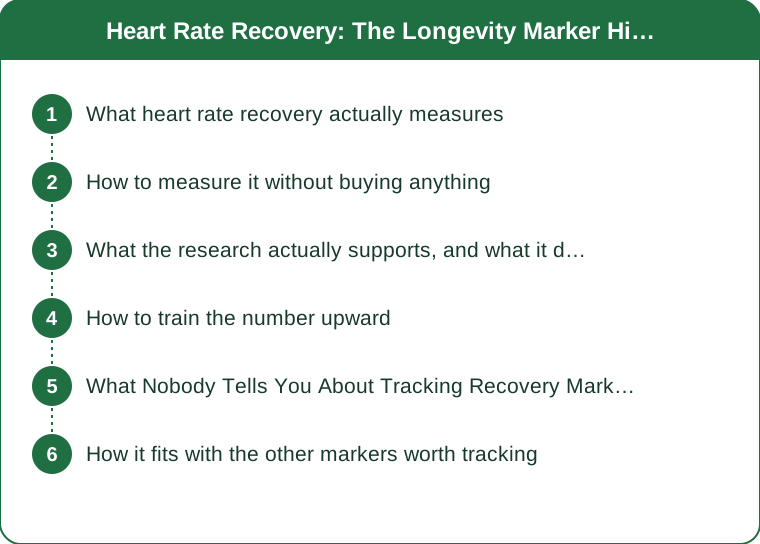
What heart rate recovery actually measures
It is a direct read on autonomic nervous system balance. During hard exercise your sympathetic branch dominates - heart rate up, blood pressure up, digestion suppressed. The moment you stop, your parasympathetic branch is supposed to reassert itself and pull the heart rate back down. How fast that happens is heart rate recovery.
The first minute is dominated by parasympathetic reactivation, specifically by the vagus nerve. Later minutes involve the gradual withdrawal of circulating adrenaline and other slower processes, which is why the one-minute number carries different information from the five-minute number.
This matters because vagal tone is not just a heart thing. The same system regulates inflammatory responses, digestion, sleep quality, and stress recovery. A sluggish return after exercise tends to travel with sluggish recovery from other stressors, which is one proposed reason the marker predicts as broadly as it appears to.
It is distinct from resting heart rate and from heart rate variability, although the three are related and tend to move together. Resting heart rate tells you where the system sits at baseline; HRV tells you about beat-to-beat regulation at rest; heart rate recovery tells you about the speed of the switch between states. The switching speed is the part most people never look at.
The landmark work came out of clinical exercise testing, where patients were followed for years after a treadmill test. Those with an abnormal one-minute recovery had substantially higher mortality over follow-up periods, and the association held after adjusting for standard risk factors and for how fit they were overall. That last point is the interesting one: it carried information beyond raw fitness.
It is not a diagnosis and it is not a substitute for medical assessment. It is a trend line about your own physiology, which is the only useful way to treat any single number of this kind. This is general information, not medical advice.
How to measure it without buying anything
Pick a repeatable effort, not a maximal one. Four to six minutes of hard steady work - a brisk uphill walk, a rowing piece, a bike effort, a set of stairs - that leaves you at roughly 80 to 90 percent of your maximum heart rate. It does not need to be an all-out test, and using an all-out test makes it harder to repeat consistently.
Stop and note the number immediately. The instant you finish, read the heart rate. This is your peak value and the whole measurement depends on catching it before it starts falling.
Stand or walk slowly for exactly 60 seconds, then read again. The difference between the two numbers is your heart rate recovery. Standing versus sitting matters, so choose one and always do the same thing, because sitting or lying down produces a faster drop and makes comparisons across days meaningless.
Interpretation, roughly: under 12 beats is the threshold most commonly used in the clinical literature to flag an abnormal response. Twelve to 20 is unremarkable. Above 20 is generally considered a healthy response, and well-trained people often see 30 to 50 beats in the first minute. Your own trend matters more than which bracket you land in.
Control the obvious confounders or the number will bounce around uselessly. Heat, caffeine, dehydration, alcohol the night before, poor sleep, and illness all blunt recovery, and in late summer heat the effect can easily be worth several beats. Measure at a similar time of day, in similar conditions, roughly once a week.
Any device that displays a pulse works, including a chest strap, a wrist watch, or fingers on the wrist counting for 15 seconds and multiplying by four. Wrist optical sensors lag during rapid changes, which is a real limitation here - a chest strap is noticeably better for this specific measurement if you have one.
What the research actually supports, and what it does not
The strongest evidence comes from large observational cohorts, where thousands of people took an exercise test and were followed for years afterward. Repeatedly, an attenuated one-minute recovery was associated with higher all-cause mortality, and the effect size was not small. Multiple independent populations have reproduced the general finding.
Association is not causation, and this distinction genuinely matters here. A slow recovery may be an early signal of underlying disease rather than a cause of anything, which would explain the mortality link without implying that improving the number extends life directly. Nobody has run the trial that would settle it, and it would be a difficult trial to run.
What is better established is that training improves the number. Aerobic training, particularly moderate steady work and interval training, improves heart rate recovery within about four to twelve weeks in most studies. So the marker is responsive, which is what makes it useful as feedback even if the causal question stays open.
It responds to things beyond cardiovascular training too. Sleep extension, reduced alcohol intake, and stress reduction practices have all been associated with improved autonomic recovery measures, which fits the interpretation that this is a general nervous system readout rather than a purely cardiac one.
The clinical thresholds come from treadmill protocols in medical settings, which is worth remembering when you apply them to a hill outside your house. Your absolute number is not directly comparable to a published cutoff, and treating a home measurement as a clinical result is the main way people misuse this.
The honest summary: a well-replicated association, a plausible mechanism, a marker that responds to training, and no proof that moving the number moves your outcome. That is enough to make it worth tracking and not enough to make it worth worrying about.

How to train the number upward
Zone 2 work is the primary lever. Sustained easy aerobic work - conversational pace, roughly 60 to 70 percent of maximum heart rate - builds the parasympathetic capacity that drives recovery speed. Two to three sessions of 30 to 45 minutes weekly is the range most commonly used, and it is also the range most people skip because it feels too easy to count.
Interval training adds a second, distinct stimulus. Repeated hard efforts with full recoveries specifically train the switch between sympathetic and parasympathetic states, which is precisely what the measurement captures. One to two sessions a week of something like six by three minutes hard with three minutes easy is a reasonable starting structure.
Do not skip the cooldown. Five to ten minutes of easy movement after hard work is not ceremonial; the gradual return is itself the trained behaviour. People who stop dead after every session tend to show worse recovery numbers than their fitness would predict.
Sleep is not a side note here. A single night of short sleep measurably blunts autonomic recovery the following day, and chronic short sleep suppresses it persistently. If your number is drifting down while your training is unchanged, sleep is the first thing to examine rather than the last.
Alcohol has an outsized and underappreciated effect, suppressing parasympathetic activity for a full 24 to 48 hours after drinking. This is one of the clearest, most reproducible things you can demonstrate to yourself with a weekly measurement, and it tends to be more persuasive than any general advice.
Give any change eight weeks before judging it. Week-to-week noise in this measurement is substantial, and the trend across two months is the only signal worth acting on.
What Nobody Tells You About Tracking Recovery Markers
The number is noisier than the apps imply. A single measurement can swing by ten beats for reasons that have nothing to do with your health - a hot room, a rushed morning, one coffee, a poor night. Treating any single reading as meaningful is the fastest route to anxiety and the slowest route to information.
Improvement is not linear and often stalls. People typically see a fast improvement in the first two months of consistent aerobic training, then a long plateau. The plateau is not failure; it is what the adaptation curve looks like once the easy gains are collected.
Chasing the number can wreck the training that improves it. The most common self-inflicted problem is adding intensity to make a marker move, which increases stress, degrades sleep, and drives the marker down. If your recovery is deteriorating while your training volume climbs, the training is the cause, not the cure.
Trends beat brackets. Whether you fall on one side or the other of a published threshold matters far less than which direction your own line has moved over the last three months, particularly given that your protocol is not the protocol those thresholds came from.
A genuinely low number is worth a conversation, not a panic. If you consistently see under 12 beats across several well-controlled measurements, that is a reasonable thing to raise with a doctor - alongside the rest of your picture, and especially if it comes with symptoms like unusual breathlessness, chest discomfort, or dizziness. Do not self-diagnose from a wrist device.
And the boring finding holds: the interventions that improve this marker are the same ones that improve nearly every other health marker. Regular aerobic work, adequate sleep, less alcohol, managed stress. The measurement is useful mainly because it gives you feedback on things you already knew you should be doing.
How it fits with the other markers worth tracking
Resting heart rate is the cheapest daily signal and the least specific. It drifts up with illness, poor sleep, alcohol, and accumulated training fatigue, which makes it excellent for spotting that something is off and useless for telling you what.
Heart rate variability tells a similar story with more resolution and more noise. It is more sensitive than resting heart rate, which is a benefit when you have months of baseline and a liability in the first few weeks when you have nothing to compare against.
Heart rate recovery adds the dimension the others miss: the speed of transition under load. Someone can have a good resting heart rate and a poor recovery, and that combination carries different information than either number alone.
None of them replaces cardiorespiratory fitness itself, which remains the best-evidenced single predictor in this whole area. If you can track only one thing, track whether your capacity for sustained hard work is improving.
A practical stack that takes almost no time: resting heart rate every morning from whatever device you already wear, heart rate recovery once weekly after a repeatable effort, and a fitness benchmark - a timed hill, a fixed distance, a step test - every eight to twelve weeks.
Then leave it alone between measurements. The value of these markers comes from the trend across seasons, and the most common mistake is checking daily and reacting weekly to what is mostly noise. Set a monthly review, look at the direction, and change one thing at a time.
TL;DR:
- Heart rate recovery is the drop in beats during the first 60 seconds after hard effort, and it reflects how fast your parasympathetic system re-engages.
- Under about 12 beats is the threshold used in clinical research to flag an abnormal response; above 20 is generally healthy and trained people often see 30 to 50.
- Measure after a repeatable four to six minute hard effort, always in the same posture, roughly weekly, controlling for heat, caffeine, alcohol and sleep.
- The mortality association is well replicated across large cohorts, but causation is unproven - the marker responds to training either way.
- Zone 2 volume, intervals, real cooldowns, sleep, and less alcohol are what move it, and eight weeks is the minimum window for judging any change.
The measurement costs sixty seconds you are already spending standing still. A consistently low reading is worth raising with a doctor rather than solving alone - this is general information, not medical advice.
Keep Reading
This article is for general informational purposes only and is not medical advice. Always consult a qualified health professional for guidance specific to you.