How Daily Walking Actually Affects Long-Term Lifespan, According to the Research
Quick Answer: Large cohort studies consistently link higher daily step counts with lower all-cause mortality risk up to roughly 7,000-8,000 steps a day, after which additional benefit levels off. Consistency and pace both matter alongside total volume, and the relationship holds across age groups, though the exact numeric threshold varies by study.
The ‘10,000 steps’ figure gets repeated constantly, but it actually originated from a 1960s Japanese marketing campaign, not a specific research finding — here’s what the actual longevity research shows instead.

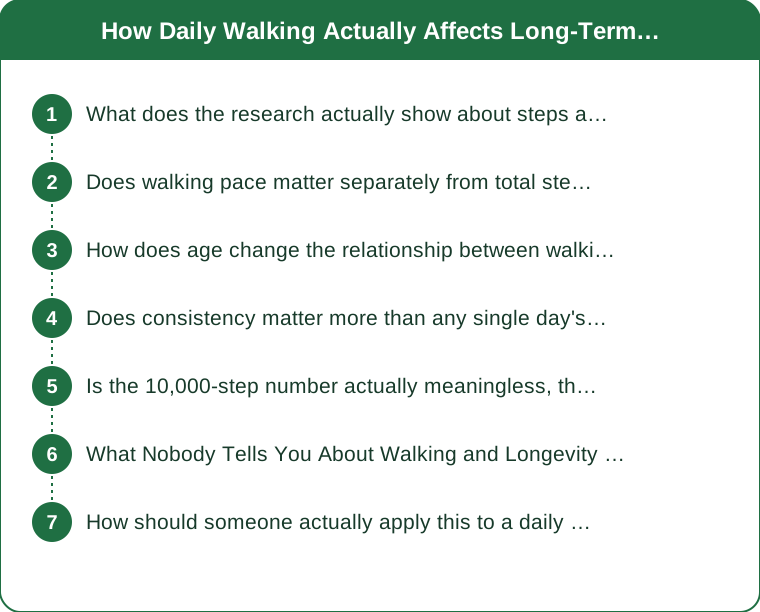
What does the research actually show about steps and mortality risk?
Multiple large observational cohort studies, including work published in JAMA Internal Medicine and other major journals, have found that all-cause mortality risk drops substantially as daily steps increase from very low levels up to roughly 7,000-8,000 steps, with the curve flattening beyond that point rather than continuing to decline steeply. This means the biggest longevity gains come from moving people out of a sedentary range, not necessarily maximizing steps beyond a moderate level.
Does walking pace matter separately from total step count?
Yes — several studies distinguish cadence, or steps-per-minute, from total daily volume, finding that periods of faster-paced walking are associated with additional cardiovascular benefit beyond what total step count alone predicts, suggesting intensity and volume both contribute somewhat independently to the overall effect.
How does age change the relationship between walking and longevity?
The mortality-risk reduction from increased walking has been observed across a wide age range, including older adults, where studies have found meaningful risk reduction even at more modest step counts than younger cohorts, which is notable given that older populations are often the most sedentary and have the most room for benefit from small increases.

Does consistency matter more than any single day’s total?
Research on physical activity patterns generally finds that consistent, regular activity produces more durable long-term health benefits than sporadic high-volume days followed by long inactive stretches, similar to how consistent moderate exercise outperforms occasional intense bursts for most cardiovascular and metabolic markers.
Is the 10,000-step number actually meaningless, then?
It’s not meaningless as a round, easy-to-remember target, but it isn’t a specific evidence-based threshold either — the research more consistently points to a benefit curve that rises steeply from sedentary levels and levels off somewhere in the 7,000-8,000 range for most mortality outcomes, which is a more nuanced and, for many people, more achievable picture than the marketing number suggests.
What Nobody Tells You About Walking and Longevity Research
Much of this research is observational, meaning it shows strong association rather than proven direct causation — people who walk more may also differ in other health-relevant ways researchers can’t fully control for. That doesn’t undermine the finding, but it does mean the precise numeric thresholds should be treated as useful general guidance rather than an exact biological cutoff that applies identically to every individual.
How should someone actually apply this to a daily routine?
Building toward a consistent 7,000-8,000 step daily average, with some portion of that at a brisker pace where possible, aligns well with the current evidence base, and importantly, moving from a very sedentary baseline toward even 4,000-5,000 steps consistently captures a large share of the available benefit before hitting more modest returns from further increases.
TL;DR:
- Mortality risk drops sharply as daily steps rise from sedentary levels to roughly 7,000-8,000
- Additional benefit beyond that range levels off rather than continuing to decline steeply
- Walking pace appears to add benefit somewhat independently of total step volume
- Consistency across most days matters more than occasional high-volume outliers
The research supports walking as a genuinely powerful, evidence-backed longevity habit — just not necessarily requiring the specific 10,000-step number most people have in their head.
Keep Reading
This article is for general informational purposes only and is not medical advice. Always consult a qualified health professional for guidance specific to you.