How Strength Training Changes What Aging Actually Looks Like
Quick Answer: Strength training does not slow a fixed aging clock - it changes which curve you are on. Muscle mass declines by roughly 3 to 8 percent per decade after 30 and accelerates after 60, but a meaningful share of that is disuse rather than biology, and it responds to resistance training in every decade tested including the nineties. The practical minimum: two full-body sessions a week, 4 to 8 hard sets per muscle group per week, taken close to failure, plus enough protein to use the stimulus.
What follows is why this single intervention touches so many separate outcomes at once.

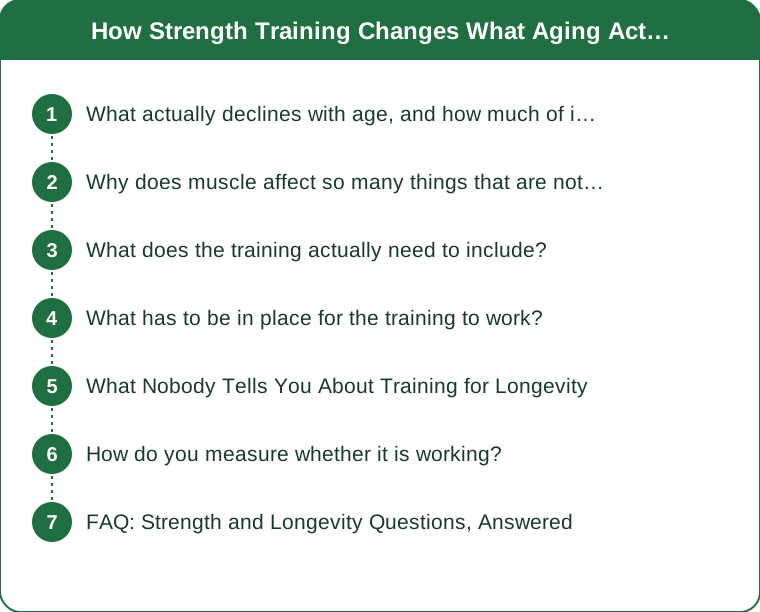
What actually declines with age, and how much of it is optional?
Three things decline on different schedules, and they are not equally negotiable.
Muscle mass declines slowly. Roughly 3 to 8 percent per decade after 30, with the rate increasing after 60. This is the number people quote, and it is the least important of the three.
Muscle strength declines faster than mass - commonly cited at around 1 to 1.5 percent per year after 50, meaning strength falls faster than the tissue that produces it. Something beyond tissue loss is happening.
Power declines fastest of all - roughly twice the rate of strength. Power is force times velocity, the ability to produce force quickly, and it is what you use to catch yourself on a stumble or stand up from a low chair.
This ordering matters enormously. It means the thing that goes first is the thing most directly tied to independence, and it is also the thing most people never train.
Underneath all three sits motor unit loss. Motor neurons are lost with age, and the fast-twitch units go preferentially. Surviving neurons reinnervate some orphaned fibres, but the fastest fibres are lost disproportionately.
And here is the part that is genuinely optional. Cross-sectional studies of lifelong masters athletes show markedly less decline in muscle mass and function than sedentary peers of the same age. The comparison is not perfect - people who train into their seventies differ in many ways from those who do not - but the intervention studies point the same direction.
Resistance training in previously untrained older adults produces strength gains of 25 to 100 percent over 8 to 12 weeks, with measurable increases in muscle cross-sectional area. This has been demonstrated in nursing home residents in their late eighties and nineties. There is no age at which the tissue stops responding.
Why does muscle affect so many things that are not muscle?
Because skeletal muscle is not only a movement organ. It is the largest metabolically active tissue in the body and it participates in systems that have nothing obvious to do with lifting.
Glucose disposal happens mostly in muscle. Skeletal muscle accounts for the majority of insulin-stimulated glucose uptake. More muscle means more places for blood glucose to go, which is one reason resistance training improves insulin sensitivity independently of weight loss.
Contraction opens a second doorway. Muscle contraction increases glucose uptake through a pathway that does not require insulin at all. This is why a short walk or a set of squats after a meal blunts the glucose response even in people with insulin resistance.
Muscle is a protein reserve for illness. During serious infection, injury, or surgery, the body catabolises muscle protein to supply amino acids for immune function and tissue repair. Someone with more muscle entering a hospital stay has more reserve to spend. This is a large part of why low muscle mass predicts worse outcomes across many acute conditions.
Loaded bone is maintained bone. Mechanical loading is the primary signal for bone remodelling. Resistance training and impact loading are among the few interventions that increase bone mineral density rather than merely slowing its loss, which matters because hip fracture in an older adult is a life-altering event with mortality attached.
Muscle releases signalling molecules. Contracting muscle secretes myokines that act on other tissues including fat, liver, bone, and brain. The research here is younger and less settled than the metabolic findings, so treat it as promising mechanism rather than established fact - but it fits a pattern where trained muscle affects systems far from the muscle itself.
And grip strength keeps showing up in mortality data. Grip strength associates with all-cause mortality across large cohorts. Grip strength is almost certainly a marker rather than a cause - squeezing a dynamometer harder does not extend life - but it is a marker of something real, and that something responds to training.
What does the training actually need to include?
Less than most people fear, and it must include one element most programmes omit.
Frequency: two full-body sessions a week. Two beats one clearly. Three beats two modestly. The gap between zero and two is enormous; the gap between two and four is small.
Volume: roughly 4 to 8 hard sets per muscle group per week to start. More produces more, with diminishing returns, and for a longevity goal rather than a physique goal the lower end is entirely adequate.
Intensity: take sets close to failure. Load matters less than proximity to failure for hypertrophy - similar growth occurs across a wide load range when sets are taken near failure. For older trainees this is good news, because moderate loads taken close to failure are joint-friendlier than heavy singles.
Progression: something must increase over time. Weight, reps, or sets. A programme performed identically for two years maintains rather than builds, and maintenance is a real goal but it should be a chosen one.
Power: this is the omission. Most older adults train slow and never train fast. Add explosive intent - the concentric portion moved as quickly as you can while controlled, with lighter loads around 40 to 60 percent of maximum. Sit-to-stands done fast, step-ups driven hard, medicine ball throws. Power declines twice as fast as strength and it is what prevents falls.
Exercise selection: cover the movements, not the muscles. A squat or leg press pattern, a hinge, a horizontal push, a horizontal pull, a vertical pull or press, and loaded carries. Loaded carries deserve specific mention - they train grip, trunk stability, and gait under load simultaneously, which is close to a direct rehearsal for daily life.
A concrete week: two sessions, each with a squat pattern for 3 sets of 8, a hinge for 3 sets of 8, a push for 3 sets of 10, a pull for 3 sets of 10, and a 40-metre carry for 3 rounds. Around 45 minutes. Add one fast-intent exercise to each session.

What has to be in place for the training to work?
Three supports, in descending order of how often they are the actual bottleneck.
Protein, particularly per meal. Older adults show anabolic resistance - the same protein dose produces a smaller muscle protein synthesis response than in younger adults. The response is dose-dependent and the threshold rises with age. Practical target: roughly 1.2 to 1.6 grams per kilogram of body weight daily, split into meals containing 25 to 40 grams each, rather than one large evening dose. Leucine content matters for triggering the response, which favours dairy, eggs, meat, fish, and soy.
Cardiorespiratory fitness alongside, not instead. VO2 max associates strongly with all-cause mortality in large cohorts, with the largest jump between the bottom quintile and the next one. Getting off the floor is worth more than optimising the top. Zone 2 work - conversational pace, 150 minutes a week - plus one harder session covers this without interfering meaningfully with strength work.
Sleep, because it gates recovery. Sleep restriction reduces muscle protein synthesis and increases the proportion of weight lost as lean mass during a deficit. A trained-but-underslept person is spending effort they do not recover from.
Two cautions worth stating plainly. First, if you are over 40, sedentary, or have any cardiovascular or metabolic condition, get medical clearance before starting, and consider a few sessions with a qualified coach to learn patterns under supervision. Second, existing joint pain is a reason to modify, not to avoid - but the modification should come from someone who can see you move.
Start below what you think you can handle. The most common failure mode in a first month is not insufficient stimulus; it is soreness severe enough to stop the next three sessions. Two sets where you planned three, for the first fortnight, costs nothing.
This is general information, not medical advice.
What Nobody Tells You About Training for Longevity
The first gains are neural, not muscular. Strength rises sharply in the first weeks with little tissue change - your nervous system is recruiting what you already have. This is real and useful, but it means early progress overstates how much muscle you have built, and it slows down later. That slowdown is not failure.
Detraining is faster than training. Two to three weeks off produces measurable strength loss, and it is faster in older adults. Retraining is quicker than the original build, but the asymmetry argues for never stopping entirely rather than for perfect consistency.
The scale will mislead you. Adding muscle while losing fat can hold body weight completely still for months. Track strength numbers, a tape measure, and how a flight of stairs feels instead.
Nobody in the gym is evaluating you. The single most common barrier to starting resistance training after 50 is the imagined audience, and it is imagined. The people who look most confident under a bar were all beginners recently enough to remember it.
Machines are not a lesser option. Free weights offer more transfer and more skill, but machines let you take a set genuinely close to failure with less technical risk. A set of leg press taken to near-failure beats a cautious squat you stop three reps early.
The uncomfortable one: consistency beats optimisation by a margin that makes most programme debates irrelevant. Two adequate sessions a week for a decade produces an outcome no perfect twelve-week block approaches. The best programme is the one still running in year five.
And the reframe worth keeping: you are not trying to look younger. You are trying to widen the gap between how long you live and how long you live well, and strength is the lever with the most direct grip on that gap.
How do you measure whether it is working?
Pick markers that track function rather than appearance, and check them rarely.
Sit-to-stand in 30 seconds. Count how many times you can stand from a standard chair without using your hands in 30 seconds. It is a validated lower-body function measure with published age norms, it needs no equipment, and it improves quickly with training.
Grip strength, if you can access a dynamometer. Many gyms and physiotherapy clinics have one. It tracks whole-body strength reasonably well and it is the measure with the most population data behind it.
Gait speed over a set distance. Walking speed predicts a great deal about function in older adults, and it is trivially easy to measure with a phone timer over 10 metres.
Your working weights. The simplest progress marker there is. Write them down - memory reliably inflates them.
Stair breathlessness as a cardio proxy. How you feel at the top of a flight you climb regularly is a crude but honest fitness signal.
Check every 8 to 12 weeks, not weekly. Adaptation is slower than measurement noise, and frequent testing mostly produces discouragement.
FAQ: Strength and Longevity Questions, Answered
Am I too old to start?
No. Resistance training produces strength and muscle gains in adults in their eighties and nineties, including frail nursing home residents. The starting point differs; the responsiveness of the tissue does not.
Is two sessions a week really enough?
For health and function, yes. Two full-body sessions capture the large majority of the available benefit. Three is modestly better; the meaningful gap is between zero and two.
Do I need heavy weights?
Not necessarily. Similar hypertrophy occurs across a wide load range when sets are taken close to failure. Heavier loads build maximal strength more efficiently, but moderate loads to near-failure are often the better trade for joints.
Should I do cardio or weights if I only have time for one?
Both matter and they cover different risks. If genuinely forced to choose, strength training protects function and independence more directly - but 150 minutes of walking a week is not a large time cost to add.
How much protein do I actually need?
Roughly 1.2 to 1.6 grams per kilogram daily for older adults, distributed across meals of 25 to 40 grams rather than concentrated in one meal.
Will lifting make me bulky?
No. Substantial muscle gain requires years of dedicated high-volume training plus a calorie surplus. The realistic outcome of two weekly sessions is being stronger at a similar size.
TL;DR:
- Muscle declines slowly, strength faster, and power fastest of all - and power is what protects independence, yet almost nobody trains it.
- The tissue responds to training at every age tested, including the nineties; the decline curve is substantially a disuse curve.
- Minimum effective dose: two full-body sessions a week, 4 to 8 hard sets per muscle group, taken close to failure, plus one fast-intent exercise per session.
- Support it with 1.2 to 1.6g/kg protein spread across meals, 150 minutes of easy cardio, and sleep - protein per meal is the most common bottleneck.
- Measure sit-to-stands, grip, gait speed, and working weights every 8 to 12 weeks, not the scale.
The honest summary is that no intervention reverses aging, and strength training does not claim to. What it does is decouple chronological age from functional age - and the size of that gap, more than the number of years, is what determines how the last two decades actually go.
This is general information, not medical advice.
Keep Reading
This article is for general informational purposes only and is not medical advice. Always consult a qualified health professional for guidance specific to you.