Sleep Quality's Underrated Role in Longevity: What the Research Actually Shows
Quick Answer: Sleep quality, particularly the amount of deep and REM sleep obtained rather than raw hours in bed, is tied to measurable long-term outcomes in cardiovascular health, metabolic function, cognitive aging, and inflammation — research increasingly treats consistent, high-quality sleep as a longevity factor on par with exercise and diet, not a secondary habit to optimize after those are already handled.
Longevity conversations reach for VO2 max charts and strength training protocols first, and sleep gets mentioned almost as an afterthought — which badly undersells how much long-term biological work actually happens during those overnight hours.

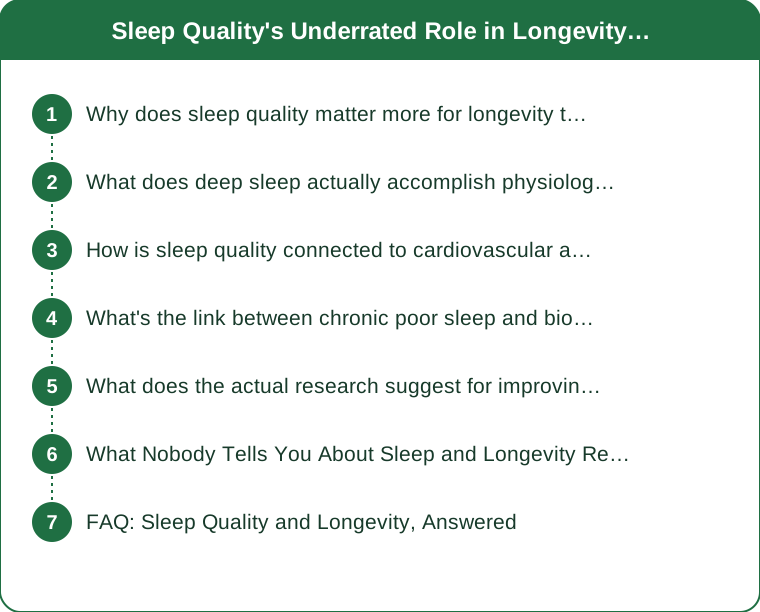
Why does sleep quality matter more for longevity than just total hours in bed?
Total time in bed and actual sleep quality are not the same measurement, and a growing body of research treats them as distinct variables with different health implications. Someone can spend eight hours in bed while getting fragmented, shallow sleep with minimal time in deep or REM stages, and the health outcomes associated with that pattern look meaningfully different from eight genuinely restorative hours.
Sleep quality specifically refers to how much time is spent in the deeper, more physiologically active stages of the sleep cycle, how often sleep is interrupted, and how consistent the sleep-wake pattern is night to night. These factors correlate with long-term health markers more strongly than simple duration alone, which is part of why two people who both report “eight hours a night” can have very different underlying sleep quality and, over years, different health trajectories.
This distinction matters practically because it changes what actually deserves attention. Someone chasing a duration target alone — simply spending more hours in bed — can still be shortchanging the deeper sleep stages that do most of the long-term physiological work, while someone with a shorter but well-structured sleep window may be getting more of the restorative benefit that actually correlates with better long-term outcomes. Sleep tracking technology has made this distinction more visible to ordinary people than it used to be, since many consumer devices now estimate time spent in different sleep stages rather than just reporting total hours slept, which has shifted public conversation gradually toward quality alongside duration.
What does deep sleep actually accomplish physiologically that makes it so important?
During deep, slow-wave sleep, the body performs a cluster of restorative processes that are difficult or impossible to replicate while awake: tissue repair accelerates, growth hormone release peaks, and the glymphatic system — the brain’s waste-clearance pathway — becomes significantly more active, flushing out metabolic byproducts that accumulate during waking hours.
This waste-clearance function has drawn particular research interest because some of the byproducts cleared during deep sleep are the same proteins implicated in long-term cognitive decline. Consistently shortchanging deep sleep, over years rather than just one bad night, is increasingly understood as removing a genuine maintenance window the brain and body depend on, not just skipping something merely pleasant.
REM sleep, the other major restorative stage, plays a distinct role in memory consolidation and emotional processing — both stages matter, and they serve different, non-interchangeable functions.
The timing of these stages across the night also matters, not just their total presence. Deep sleep is concentrated more heavily in the first half of a typical night’s sleep, while REM sleep becomes proportionally more prominent in the second half — this is part of why cutting sleep short from either end of the night has a genuinely different physiological effect. Going to bed late but still waking at a normal time disproportionately cuts into deep sleep, while waking unusually early disproportionately cuts into REM, which is a more nuanced picture than the simple “just get more hours” framing usually captures.
How is sleep quality connected to cardiovascular and metabolic longevity markers specifically?
Poor sleep quality, including sleep that’s fragmented or insufficient in deep stages, has been associated in research with elevated blood pressure, impaired glucose regulation, and unfavorable shifts in appetite-regulating hormones like leptin and ghrelin. Over time, these are exactly the kind of incremental physiological shifts that compound into meaningfully higher cardiovascular and metabolic disease risk.
One of the more striking findings in this area involves glucose metabolism specifically: even a single stretch of several nights of reduced or poor-quality sleep can measurably impair insulin sensitivity in otherwise healthy people, an effect that reverses with recovered sleep but illustrates how directly sleep quality feeds into metabolic function on a fairly short timescale.
This is part of why some longevity researchers now treat sleep quality as a modifiable risk factor deserving the same level of attention as blood pressure or cholesterol — it’s not just correlated with those markers, it appears to causally influence them.
Blood pressure specifically shows an interesting pattern tied to sleep stages: blood pressure normally dips during healthy deep sleep, a phenomenon sometimes called nocturnal dipping, and this dip is itself associated with better long-term cardiovascular outcomes. People whose sleep is chronically fragmented or shallow often show a blunted or absent version of this normal nighttime dip, and that blunted pattern has been independently associated with elevated cardiovascular risk in longitudinal research, separate from daytime blood pressure readings alone.

What’s the link between chronic poor sleep and biological aging or inflammation?
Chronic sleep disruption is associated with elevated markers of systemic inflammation, including C-reactive protein and various inflammatory cytokines, which are themselves linked to a broad range of age-related conditions when persistently elevated over years. This connection has led some researchers to describe poor sleep as a form of chronic low-grade physiological stress, similar in its cumulative effect to other recognized inflammation drivers.
Some studies using biological age markers — measurements that estimate how “old” cells and tissues appear relative to chronological age — have found associations between consistently poor sleep quality and accelerated biological aging markers, independent of chronological age itself. This research area is still developing, but the directional pattern across multiple studies points the same way: sleep quality isn’t just a comfort factor, it appears to interact with the biological processes underlying aging itself.
One specific area of ongoing research involves telomeres — the protective caps on chromosomes that shorten somewhat with each cell division and are sometimes used as a rough marker of cellular aging. Several studies have found associations between poor sleep quality and shorter telomere length, though this research field is still working out how much of that relationship is directly causal versus reflecting other factors that track alongside poor sleep, like chronic stress or unmanaged health conditions. Even accounting for that uncertainty, the consistent directional pattern across multiple independent research approaches is part of what has elevated sleep quality’s standing in longevity science over the past decade.
What does the actual research suggest for improving sleep quality, not just sleep duration?
A handful of specific, well-supported habits consistently show up across sleep research as genuinely effective for improving sleep quality rather than just time spent in bed: a consistent sleep and wake time, even on weekends, which helps stabilize circadian rhythm and appears to improve deep sleep proportion over weeks of consistency; a cool, dark sleep environment, since core body temperature drop is part of what triggers and sustains deeper sleep stages; and reduced light exposure, particularly blue light, in the hour or two before bed, since light exposure directly suppresses melatonin production timing.
Alcohol close to bedtime is worth specifically flagging here — it’s commonly misunderstood as sleep-promoting because it can speed up falling asleep, but research consistently shows it fragments sleep architecture later in the night and meaningfully reduces REM sleep, which undercuts the very restorative processes this section has been describing. The pattern that improves sleep quality specifically, rather than just making someone feel drowsy at bedtime, tends to be less dramatic and more consistency-based than most people expect.
Daytime habits matter here too, not just the bedtime routine itself. Morning and early-afternoon exposure to natural light helps anchor circadian rhythm in a way that makes evening melatonin release more reliably timed later that same night, and regular physical activity — independent of when it happens during the day, though not too close to bedtime for some people — is consistently associated with improved deep sleep proportion in research. None of these individual habits produces a dramatic overnight change on its own; the research pattern is much more about consistent, compounding small adjustments building meaningfully better sleep architecture over a period of weeks rather than days.
What Nobody Tells You About Sleep and Longevity Research
Sleep quality research has consistently found that inconsistent sleep timing — going to bed and waking up at wildly different times night to night — carries measurable health risk independent of total sleep duration. Someone who averages eight hours a night but with wildly variable timing can show worse metabolic and cardiovascular markers than someone getting a slightly shorter but highly consistent sleep schedule.
This finding surprises people because most sleep advice focuses almost entirely on duration (“get eight hours”) and quality factors like darkness or temperature, while consistency of timing gets far less attention despite showing up repeatedly as an independent risk factor in its own right. A sleep schedule that varies by two or three hours across a typical week is more common than most people realize, and it’s one of the more overlooked longevity-relevant sleep factors in mainstream advice.
This phenomenon has picked up the informal name “social jetlag” in some sleep research — describing the mismatch between a person’s weekday sleep schedule (often constrained by work or school) and their weekend schedule (often shifted later by choice). The size of that mismatch, measured in hours of shift between weekday and weekend sleep midpoint, has been associated in several studies with worse metabolic markers, even when total weekly sleep duration works out to be similar between someone with a large mismatch and someone with a small one. It’s a genuinely underappreciated piece of the sleep-longevity picture precisely because it doesn’t show up in a simple “hours slept” number at all.
FAQ: Sleep Quality and Longevity, Answered
Is there a specific number of deep sleep hours to aim for each night?
Most adults spend roughly 13-23% of total sleep time in deep sleep stages under normal, healthy conditions, though this naturally declines somewhat with age — tracking devices offer estimates, though lab-grade sleep studies remain more accurate for anyone with a specific medical concern.
Can sleep quality actually be improved without changing total sleep duration at all?
Yes — consistent timing, a cooler and darker environment, and reduced evening light exposure can meaningfully shift the proportion of deep and REM sleep within the same total sleep window, independent of adding more hours.
Should chronic poor sleep quality be evaluated medically rather than just self-managed with better habits?
If sleep quality issues persist despite consistent good sleep habits, or if there are signs of a sleep disorder like frequent loud snoring, gasping, or excessive daytime sleepiness, a medical evaluation is warranted rather than continuing to self-manage — sleep disorders like sleep apnea are common, underdiagnosed, and specifically disrupt the deep sleep stages this article has focused on, which makes them a meaningful blind spot in any self-directed sleep improvement effort. This is general information, not medical advice.
TL;DR:
- Sleep quality, not just total hours, is what correlates most strongly with long-term health outcomes
- Deep sleep drives tissue repair and brain waste clearance; REM handles memory and emotional processing
- Poor sleep quality is linked to worse cardiovascular, metabolic, and inflammatory markers over time
- Consistent sleep-wake timing is an independent, often-overlooked longevity factor beyond duration alone
Sleep deserves a seat at the same table as strength training and VO2 max in any real longevity conversation — the overnight hours are doing more measurable long-term biological work than the wellness conversation usually gives them credit for. This is general information, not medical advice.
Keep Reading
This article is for general informational purposes only and is not medical advice. Always consult a qualified health professional for guidance specific to you.