The Four Capacities That Decide How You Move at Eighty
Quick Answer: Whether you are independent at 80 comes down to four measurable capacities: cardiorespiratory fitness, muscular strength and power, balance, and joint range of motion. Each declines on its own schedule, each is trainable well into later life, and each has a rough threshold below which everyday tasks become impossible.
The critical insight is that you are not trying to stop decline - you are trying to start from high enough that decline never crosses the threshold. Someone who reaches 60 with a high capacity and loses ground at the same rate as everyone else still ends up above the line at 85.
Here is what each capacity does, how fast it goes, what the threshold looks like, and what training preserves it.

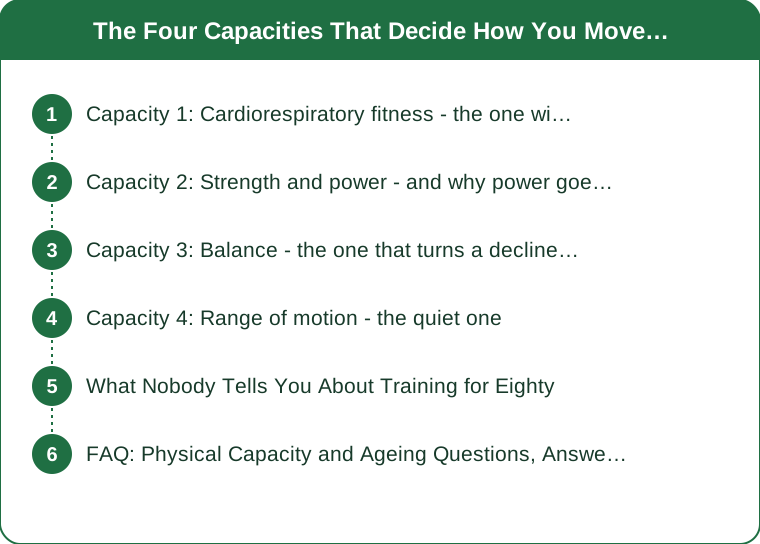
Capacity 1: Cardiorespiratory fitness - the one with the strongest evidence
VO2 max - the maximum rate at which your body can use oxygen - is among the most robust predictors of all-cause mortality in the research literature, and its association is stronger than many of the risk factors that get far more clinical attention.
How fast it declines. Roughly 10 percent per decade after around 30 in sedentary people, accelerating after 60 and again after 70. That is not a gentle slope - a 50 percent loss between 30 and 80 is typical, and it is the single largest driver of the sensation that everything got harder.
Where the threshold sits. Independent living requires roughly 18 mL/kg/min for most everyday tasks. Below about 15, ordinary activity - stairs, carrying shopping, walking to a bus - becomes a maximal effort. A sedentary 30-year-old woman might sit around 33; a trained one around 45. The trained one crosses the threshold decades later, or never.
What actually preserves it. The evidence favours a combination:
- Zone 2 work - conversational pace, sustained. Three to four hours weekly builds the aerobic base, mitochondrial density, and fat oxidation. This is the bulk of the work and it is boring, which is why people skip it
- High-intensity intervals, once or twice weekly. Four minutes hard, three minutes easy, repeated four times is the most-studied protocol and it drives VO2 max specifically, which zone 2 alone does less efficiently
- Consistency over intensity. The gap between doing nothing and doing something is far larger than the gap between moderate and optimal
The encouraging part: VO2 max responds to training at any age, including in the eighties. Studies on previously sedentary older adults consistently find meaningful improvement within 12 weeks. You are never starting too late; you are only ever starting from lower.
The practical measure most people can use: how you feel on a flight of stairs, or a timed walk. If a brisk 12-minute walk leaves you unable to speak in sentences, that is useful information long before any laboratory test.
Capacity 2: Strength and power - and why power goes first
Muscle mass and strength decline with age - sarcopenia - but the more important and less discussed fact is that power declines roughly twice as fast as strength.
Strength is how much you can move; power is how fast you can move it. Power depends on fast-twitch fibres, which are preferentially lost with age, and it is power - not strength - that determines whether you can catch yourself when you stumble or stand up quickly from a chair.
The numbers. Muscle mass declines around 3 to 8 percent per decade after 30, accelerating after 60. Strength declines faster than mass, because the nervous system’s ability to recruit fibres also degrades. Power declines faster still - as much as 3 to 4 percent per year in later decades.
Where the thresholds sit. The functional tests are more useful than the numbers:
- Standing from a chair without using your hands. Five repetitions in under 12 seconds is a common benchmark
- The sitting-rising test - getting to the floor and back up with minimal support. Scores on this test correlate with mortality in published research, which sounds dramatic and reflects how much integrated capacity it requires
- Carrying half your bodyweight for 30 metres, which covers most real-world carrying tasks
- Grip strength, which is measured clinically precisely because it proxies for whole-body strength so effectively
What preserves it. Resistance training, twice weekly minimum, is non-negotiable and there is no substitute. Walking does not preserve strength. Yoga does not preserve strength. The specific requirements:
- Progressive load. The weight must increase over time or adaptation stops
- Compound movements - squats, hinges, presses, rows, carries - which train the patterns life actually uses
- Explicit power work after 50. Fast concentric movement - jumping, throwing a medicine ball, standing up from a chair quickly and deliberately. Slow heavy lifting alone does not preserve power, and this is the most commonly missed piece in older adults’ training
- Adequate protein. Older adults need more protein per meal to trigger the same muscle protein synthesis response - the tissue becomes less responsive, so the stimulus has to be larger
And the recoverability point: older adults gain strength at a similar relative rate to younger ones. The gains are real, they arrive within 8 to 12 weeks, and the studies demonstrating this include participants in their nineties.
Capacity 3: Balance - the one that turns a decline into an event
Balance is the capacity where loss stops being gradual and becomes sudden. A fall is the mechanism by which slow decline turns into a hospital admission, and after a hip fracture in later life, outcomes are frequently poor.
Why it declines. Balance is assembled from three inputs - vision, the vestibular system, and proprioception - integrated by a nervous system that must then produce a fast corrective muscle response. All four components degrade with age, and they degrade at different rates, which is why the loss can feel abrupt.
The power connection matters here. Recovering from a stumble is a power task - you have a fraction of a second to produce a large corrective force. This is why power training is fall prevention, not just performance training, and it is the most underappreciated link in this entire list.
Where the thresholds sit:
- Single-leg stand, eyes open. Under 10 seconds after 60 is associated with elevated risk in published work
- Single-leg stand, eyes closed. Considerably harder and a better test of proprioception. A few seconds is normal; being unable to do it at all is worth addressing
- Tandem stance - one foot directly in front of the other - held for 30 seconds
What preserves it. Balance is the most trainable capacity on this list and the most neglected:
- Daily practice, small doses. Two or three minutes daily beats a long weekly session for this specific adaptation. Do it while the kettle boils
- Progressive challenge: two feet eyes closed, then single leg eyes open, then single leg eyes closed, then head turns while balancing
- Train it under load. Single-leg strength work - split squats, step-ups, single-leg deadlifts - builds balance and strength at once and transfers better than static holds alone
- Reactive practice. Being lightly nudged, or stepping onto uneven ground, trains the corrective response rather than just the holding position
Tai chi has unusually good evidence for fall prevention, and it works largely because it combines slow controlled weight shifting with continuous single-leg loading. If someone will do tai chi and will not do balance drills, tai chi wins.

Capacity 4: Range of motion - the quiet one
Joint range gets the least attention and produces some of the most limiting losses, because losing range does not hurt and does not announce itself. You simply stop being able to reach the top shelf, and you adapt without noticing.
Why it declines. Connective tissue loses water content and elasticity with age, joint surfaces change, and - most importantly - you stop using the end ranges. Range is lost primarily through disuse, and disuse compounds: less range means fewer positions used, which means less range.
The three that matter most functionally:
- Shoulder flexion - reaching overhead. Loss here means you cannot reach a high shelf, wash your own hair comfortably, or put on a coat easily. It is one of the most common and most limiting losses
- Hip extension and rotation. Determines walking gait, and stride length is a direct component of walking speed - which is itself a strong predictor of later-life outcomes
- Ankle dorsiflexion. Determines whether you can squat, descend stairs comfortably, and recover from a trip. Limited ankle range is quietly involved in a large fraction of balance problems
Where the thresholds sit. Functional rather than numerical: can you reach both hands overhead against a wall with your back flat? Can you sit on the floor and get up? Can you touch your toes with soft knees? Can you get your knee past your toes in a knee-to-wall test?
What preserves it:
- Full range strength training. This is the most efficient answer by a wide margin - a deep squat, an overhead press, a full-range row all maintain range while building strength. Loaded stretching beats passive stretching for retention
- Daily movement through end ranges, even unloaded. Five minutes, every day
- Getting on and off the floor regularly. The single most functionally relevant habit on this page - it requires hip, knee, ankle, and shoulder range plus strength and balance simultaneously
- Not sitting for eight uninterrupted hours. The hips adapt to the position they spend the most time in
Range comes back slower than strength but it does come back. Expect 8 to 12 weeks for meaningful change and treat it as a permanent habit rather than a project.
What Nobody Tells You About Training for Eighty
The starting height matters more than the rate of decline. This is the central point and it is genuinely liberating. You cannot stop the decline curve - but you can move the whole curve upward. Two people declining at identical rates end up in completely different places if one started 40 percent higher. Everything you build at 40 is buying you distance from the threshold at 80.
The capacities interact rather than adding up. Poor ankle range causes balance problems. Low power causes falls. Low VO2 max means you walk less, which costs strength and balance. Improving one tends to improve the others, and neglecting one undermines the rest.
Detraining is faster than training, especially later. Two weeks of bed rest costs an older adult a disproportionate amount of muscle, and it is harder to rebuild than it was to lose. This is the strongest argument for maintaining something during illness or injury - even a reduced version.
Walking is necessary and insufficient. It is excellent for cardiovascular health, mood, and general activity. It does not build strength, it does not build power, it does not challenge balance, and it does not maintain range. People who walk daily and do nothing else still lose all four capacities on schedule.
The floor test is the best single self-assessment. Get down to the floor and back up. It integrates strength, power, balance, and range in one movement. If it is getting harder, something on this list is declining, and it is a far better early warning than a scale.
And the minimum effective programme is smaller than people fear. Two strength sessions, three hours of easy cardio, one interval session, and five minutes of daily balance and range work. That is roughly five hours a week to address all four capacities. It is less than most people spend on any single evening habit.
FAQ: Physical Capacity and Ageing Questions, Answered
Is it too late to start at 60, or 70?
No, and this is one of the better-supported findings in the field - studies on previously sedentary adults in their seventies, eighties, and nineties consistently find meaningful improvements in strength, VO2 max, and balance within 12 weeks. The gains are proportionally similar to those in younger people.
Which capacity should I prioritise if I only have time for one thing?
Strength training, because it is the only one with no substitute and it partially supports the other three. Two sessions a week with progressive load covers more ground than any other single choice.
How do I train power safely if I have joint issues?
Power means fast intent, not necessarily impact - a fast concentric on a leg press, a medicine ball throw, or standing quickly from a chair all train power without loading a painful joint. Speak to a physiotherapist about which patterns suit your specific situation.
Does any supplement meaningfully affect these capacities?
Adequate protein and vitamin D have the clearest support, and creatine has reasonable evidence for strength and muscle mass in older adults. None of them substitute for the training, and this is general information rather than medical advice - discuss supplements with your clinician, particularly alongside medication.
TL;DR:
- Four capacities decide later-life independence: aerobic fitness, strength and power, balance, and range
- You cannot stop decline, but starting higher means never crossing the threshold
- Power declines twice as fast as strength and is what catches you when you stumble
- Balance is the most trainable and most neglected - two minutes daily beats a weekly session
- Strength training is the one with no substitute; walking alone preserves none of the four
Get down to the floor and stand back up, and notice what it takes. That single movement is the most honest test on this page.
Keep Reading
This article is for general informational purposes only and is not medical advice. Always consult a qualified health professional for guidance specific to you.