The One Longevity Metric Almost Nobody Tracks (and Why It Predicts More Than Weight or BMI)
Quick Answer: Grip strength has repeatedly outperformed BMI and even some standard cardiovascular measures as a predictor of overall mortality risk in large longitudinal studies, because it functions as a reliable proxy for total-body muscle quality and neuromuscular health — and unlike many longevity markers, it’s simple enough to track at home.
Most people can recite their weight or step count from memory. Almost nobody can tell you their grip strength, despite it being one of the more consistently validated longevity signals in the research.

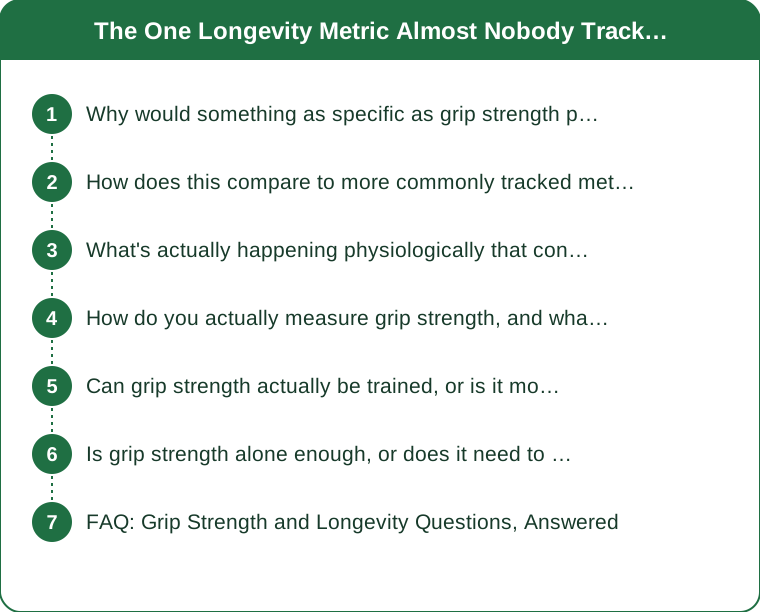
Why would something as specific as grip strength predict something as broad as mortality risk?
Grip strength isn’t really measuring hand strength in isolation — it’s functioning as an easily measurable proxy for total-body muscle quality, since hand and forearm strength correlates closely with overall muscular health across large population studies.
Several large longitudinal studies, including analyses drawing on hundreds of thousands of participants, have found grip strength predicting all-cause mortality risk more consistently than blood pressure in some models, which is part of why researchers have taken it seriously as a standalone marker rather than dismissing it as a minor measure.
How does this compare to more commonly tracked metrics like BMI?
BMI doesn’t distinguish between muscle and fat mass, which limits its usefulness as a health predictor for anyone with above-average muscle mass — a limitation grip strength doesn’t share, since it directly reflects functional muscular capacity rather than a weight-to-height ratio.
That doesn’t mean BMI is useless, but grip strength adds information BMI structurally cannot capture, which is why researchers increasingly treat them as complementary rather than interchangeable metrics.
What’s actually happening physiologically that connects grip strength to longevity?
Grip strength declines with sarcopenia, the age-related loss of muscle mass and function, making it an early, measurable signal of a broader physiological process that also affects mobility, fall risk, and metabolic health.
Neuromuscular efficiency — how well your nervous system recruits muscle fibers — also declines with age and shows up in grip strength measurements, meaning the metric captures more than raw muscle size alone; it reflects a functional system, not just a tissue measurement.

How do you actually measure grip strength, and what’s a good number to aim for?
A hand dynamometer, a relatively inexpensive tool, gives an objective reading in kilograms of force, with population-based reference ranges available by age and sex to compare your result against.
Without a dynamometer, a simple dead hang from a pull-up bar, timed for as long as you can hold it, offers a rough proxy — while not as precise, meaningful improvement over weeks of consistent training is still a useful signal.
Can grip strength actually be trained, or is it mostly fixed by genetics?
Grip strength responds well to targeted training — farmer’s carries, dead hangs, and simply training compound lifts without wrist straps all build it over time, meaning it’s a modifiable metric, not a fixed trait.
Consistency matters more than intensity here — brief, regular grip-focused work (a few minutes, a few times a week) tends to produce steady improvement over months, similar to how other strength qualities develop.
Is grip strength alone enough, or does it need to be paired with other markers?
No single metric captures overall health on its own, and grip strength is best used alongside other markers like VO2 max, walking speed, and standard bloodwork, rather than as a sole indicator.
What makes it valuable isn’t that it replaces other measures — it’s that it’s simple enough to actually track consistently, which is more than can be said for some more complex longevity markers that require lab visits or specialized equipment.
FAQ: Grip Strength and Longevity Questions, Answered
At what age does grip strength typically start declining?
Measurable decline often begins in the 40s, though the rate varies significantly based on strength training habits maintained throughout life.
Is a dead hang test accurate enough to actually track progress?
It’s a reasonable rough proxy for tracking your own trend over time, though it’s less precise than a dynamometer for comparing against population reference ranges.
Does grip strength training also help with other areas of fitness?
Yes — grip is a limiting factor in many pulling and carrying exercises, so improving it often indirectly supports progress in deadlifts, rows, and farmer’s carry-style training.
TL;DR:
- Grip strength has outperformed BMI in some studies as a predictor of all-cause mortality risk
- It functions as a proxy for total-body muscle quality and neuromuscular health, not just hand strength
- A hand dynamometer or simple dead hang test can track it at home over time
- Grip strength is trainable through farmer’s carries, dead hangs, and strap-free compound lifts
It’s rarely tracked, but the research behind it is some of the more consistent longevity evidence available — worth a spot next to your other health numbers.
Keep Reading
This article is for general informational purposes only and is not medical advice. Always consult a qualified health professional for guidance specific to you.