Your Walking Speed Is Quietly Predicting Your Healthspan — Here's How to Read It
Quick Answer: Usual walking speed is one of the strongest simple predictors of long-term health — large studies link faster habitual pace (roughly 3+ mph or a 20-minute mile) with meaningfully longer life expectancy. Test yours over a measured 10 meters, and train it with posture, cadence, and 30-second brisk intervals rather than just ‘walking more.’
No lab, no wearable, no blood draw — researchers can learn a startling amount about your next couple of decades by timing you across a hallway. The good news: unlike your birth year, this number trains.

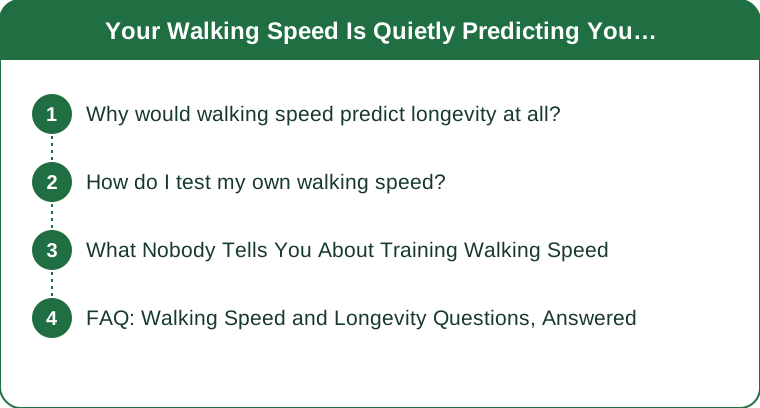
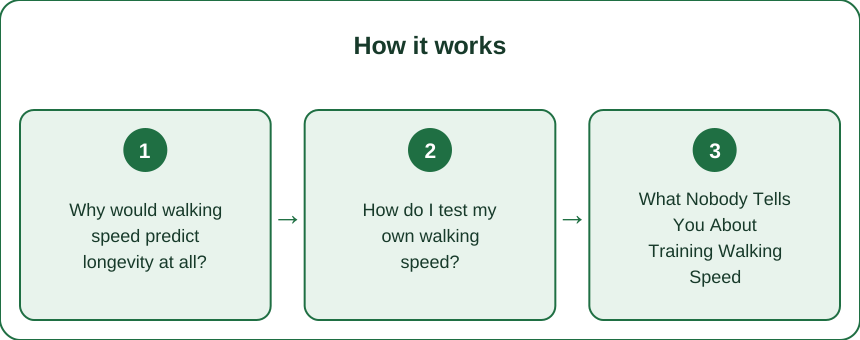
Why would walking speed predict longevity at all?
Because walking fast is secretly a full-system audit. A brisk pace requires your heart and lungs to deliver oxygen, your legs to produce power, your joints to tolerate load, your balance system to manage single-leg moments, and your nervous system to coordinate all of it — every stride.
Slowing down is often the first visible sign that one of those systems is losing capacity, years before anything shows up in a checkup. That’s why large pooled studies (tens of thousands of adults) keep finding that habitual gait speed stratifies long-term outcomes better than many single measurements.
Important framing: speed is a signal, not a virtue. The goal isn’t to speed-walk everywhere — it’s to own a body that can.
How do I test my own walking speed?
The clinical version is simple enough to copy at home:
- Measure a straight 10 meters (about 33 feet — a hallway or driveway works).
- Walk it at your normal, comfortable pace — not a test-day sprint. Start walking a couple of steps before the line so you’re timed at speed.
- Time it, run it twice, average.
Reading your result: 10 meters in about 7 seconds ≈ 1.4 m/s (3.1 mph) — a strong pace associated with the best outcome tiers. Around 10 seconds ≈ 1.0 m/s, the middle of the range. Much over 12-13 seconds at a comfortable pace is worth discussing with a clinician, especially alongside fatigue or balance changes.
Retest quarterly. The trend tells you more than any single number. This is general information, not medical advice.

What Nobody Tells You About Training Walking Speed
‘Walk more’ barely moves the needle. Speed responds to specific inputs, and the biggest one surprises people: it’s not cardio — it’s leg power.
Stride length and push-off force come from hip and calf strength, which is why the most effective speed program looks half like a gym plan:
- Sit-to-stands from a chair: 3 sets of 10, no hands, daily-ish. The single best functional leg-power builder.
- Calf raises: 3 sets of 12-15 — push-off lives here.
- Brisk intervals: on 2-3 walks a week, add 6-8 rounds of 30 seconds noticeably-fast / 90 seconds easy.
- Cadence cue: count steps for 20 seconds; nudging from, say, 36 to 38-40 quickens your natural rhythm without feeling forced.
Expect a measurable 10-meter improvement within 8-12 weeks — this metric is famously trainable at every age.
FAQ: Walking Speed and Longevity Questions, Answered
Is a slower pace ever just… fine?
Context matters — terrain, height, injury history all shift the number. The concern isn’t one slow reading; it’s a comfortable pace that’s clearly declining or sits well below the reference ranges despite no obvious reason. That’s a conversation with a professional, not a panic.
Does treadmill speed count for testing?
Use it for training, not testing — treadmill belts standardize your gait and read slightly different from overground pace. The 10-meter hallway test is the comparable number.
I’m in my 30s — isn’t this an older-person metric?
The predictive research skews older, but the capacity you’ll have at 70 is being banked now. A strong pace plus leg power in your 30s-40s is the cheapest longevity investment on this list.
TL;DR:
- Habitual walking speed is a whole-body audit: heart, lungs, leg power, balance in one number
- Self-test: 10 meters at comfortable pace — ~7 seconds is strong, trend matters more than one reading
- Train it with leg power (sit-to-stands, calf raises) + 30-second brisk intervals, not just ‘more steps’
- Declining or notably slow pace = worth a professional conversation, not a panic
You walk thousands of steps a day anyway — might as well make them a fitness program disguised as an errand. This is general information, not medical advice.
Keep Reading
This article is for general informational purposes only and is not medical advice. Always consult a qualified health professional for guidance specific to you.