Why Grip Strength Predicts How Well You Age Better Than Almost Anything Else
Quick Answer: Grip strength predicts ageing outcomes because it is a cheap, reliable proxy for total-body muscle strength, neuromuscular integrity and cumulative health — all in one measurement that takes ten seconds. Large prospective studies have found grip strength associated with all-cause mortality, cardiovascular events, cognitive decline and future disability, often more strongly than blood pressure. It is not that hands are magic; it is that grip is the easiest honest window into system-wide capacity.
A device that costs less than a pair of trainers, a ten-second squeeze, and a number that carries more predictive weight than most of what happens in an annual check-up.
That should be surprising. Here is why it is not.

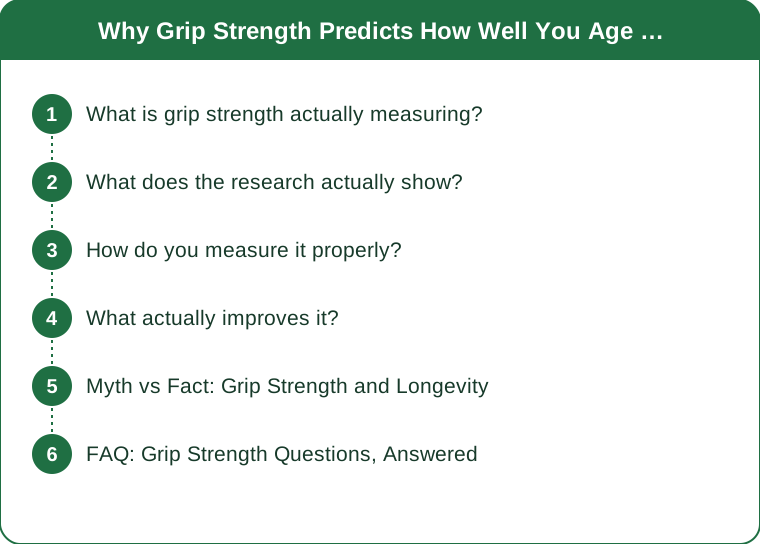
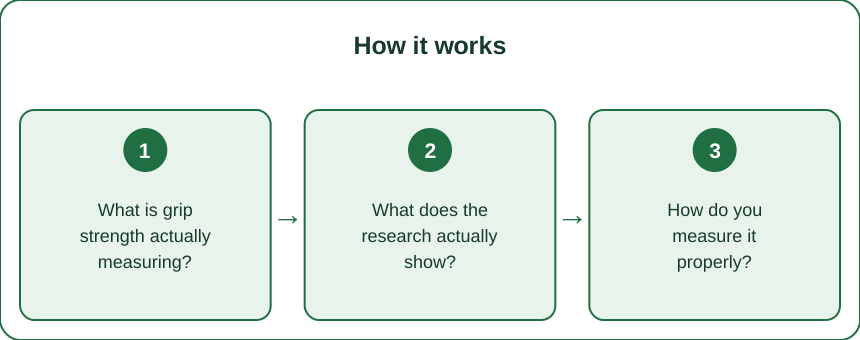
What is grip strength actually measuring?
Not your hands. It is a readout of several systems at once, which is precisely why it works so well as a predictor.
It is a proxy for total muscle strength. Grip correlates strongly with strength elsewhere in the body — leg strength, trunk strength, overall lean mass. A weak grip in an otherwise healthy person is unusual, because strength is a systemic property rather than a local one.
It reflects neuromuscular function. Producing maximal force requires the nervous system to recruit motor units rapidly and synchronously. Age-related decline in that recruitment shows up in grip before it shows up in most functional tasks, because grip is measured maximally and daily tasks are not.
It integrates cumulative health history. Chronic inflammation, malnutrition, prolonged illness, sedentary behaviour and undertreated chronic disease all reduce muscle mass and quality. Grip captures the net result of all of them in one number without needing to identify any individually.
It captures sarcopenia early. Age-related loss of muscle mass and function begins in midlife and accelerates. Grip strength is one of the diagnostic criteria for sarcopenia in major international definitions, precisely because it detects the functional consequence rather than just the mass.
It is exceptionally reliable to measure. A calibrated hand dynamometer produces consistent, comparable numbers across settings, populations and decades. That measurement quality is a large part of why it appears so consistently in the research — many other useful markers are measured badly.
It does not require expensive equipment or a lab. Anything that can be measured in a community setting for a few pounds gets measured in enormous cohort studies, which means the evidence base is very large.
Crucially, it is not causal on its own. Squeezing a device harder does not extend your life. Grip is a marker for the underlying strength and health that do matter, which is why the intervention is whole-body training rather than hand exercises.
What does the research actually show?
A consistent pattern across very large populations, with some important nuance about what it means.
Large prospective cohorts find a consistent association with mortality. Studies following hundreds of thousands of adults over years have found lower grip strength associated with higher all-cause mortality, with the relationship holding after adjusting for age, sex, body size, socioeconomic factors and existing disease.
The association extends to cardiovascular outcomes. Grip strength has been associated with cardiovascular mortality and incident cardiovascular events in multiple large studies, and in some analyses the association was stronger than that of systolic blood pressure.
Cognitive outcomes show a relationship too. Lower grip strength has been associated with faster cognitive decline and higher dementia risk in several cohorts. The mechanism is likely shared — vascular health, physical activity, inflammation and neural integrity all affect both.
It predicts future disability and falls. Grip strength in midlife is associated with functional limitation decades later, which makes it useful as an early warning rather than only a late-stage marker.
Relative grip may matter more than absolute. Several analyses suggest grip strength normalised to body mass is a stronger predictor than raw kilograms, which makes intuitive sense — the relevant question is how much strength you have per unit of body to move.
Trajectory beats a single reading. A number today tells you where you sit. The change over five years tells you considerably more, and decline that is faster than expected for your age is the finding worth acting on.
Association is not causation, and this matters practically. Nobody credibly argues that training your grip in isolation improves longevity. The reasonable interpretation is that grip reveals something real, and the something real responds to whole-body resistance training. This is general information, not medical advice.
How do you measure it properly?
Correctly enough that the number means something, which requires a little more care than squeezing once.
Use a calibrated hand dynamometer. Hydraulic or digital models are widely available for home use. Consistency of device matters more than which device, because readings vary between models.
Standardise the position. The widely used protocol is seated, shoulder adducted and neutral, elbow bent at 90 degrees, forearm neutral, wrist slightly extended. Changing the position changes the number substantially.
Take three attempts per hand and record the highest. Rest at least 15 to 30 seconds between attempts. Averaging is also used; what matters is doing the same thing every time.
Test at the same time of day. Strength varies through the day and grip is no exception. Morning readings are typically slightly lower.
Record both hands separately. A large asymmetry beyond the usual small dominant-hand advantage is worth noting.
Compare against age and sex norms, then against yourself. Published reference ranges exist for most populations. But your own trajectory over years is the more useful comparison, because it removes all the between-person variation.
Retest every three to six months. More often than that and you are measuring noise. Less often and you miss a trend.
Do not test when unwell or immediately after training. Acute illness and fatigue both depress the reading and produce a misleading data point.
Rough orientation for adults: typical values vary widely by age and sex, and the reference tables are easy to find. A reading well below the norm for your age group, or a decline of more than a few kilograms year over year in midlife, is the signal worth discussing with a clinician.

What actually improves it?
Whole-body resistance training, with some specific attention to loaded carries and pulling. Not hand grippers.
Resistance training is the primary intervention. Two to three sessions per week of progressive resistance training improves strength systemically, and grip improves alongside it. This is the intervention with the strongest evidence for the outcomes grip predicts.
Loaded carries are the single most direct exercise. Farmer’s carries, suitcase carries and trap bar carries load the grip under time and require the whole body to stabilise. Two to four sets of 30 to 45 seconds, twice a week, produces noticeable change within a month.
Pull without straps. Deadlifts, rows and pull-ups all train grip substantially if you do not use lifting straps. Using straps for every heavy set is the most common reason a strong lifter has a mediocre grip.
Dead hangs are cheap and effective. Hanging from a bar for accumulated time — starting with 10 to 20 seconds and building toward a minute — trains grip endurance and is also good for shoulder health.
Train the legs and back too. Because grip is a proxy, improving it meaningfully means improving the system it is a proxy for. Squats, hinges and rows do more for your grip reading over a year than any hand-specific work.
Protein intake supports the adaptation. Muscle protein synthesis requires adequate protein, and requirements are somewhat higher in older adults. Roughly 1.2 to 1.6 grams per kilogram of body weight per day is a commonly cited target for people doing resistance training.
Do not neglect it in your forties. The decline begins earlier than most people assume, and the trajectory is much easier to change before it steepens than after.
Grip trainers have a narrow role. Spring grippers build crushing strength, which is not the same as the sustained support grip that carries and hangs train. They are not harmful, they are just not the main lever.
Seasonal note: grip and forearm work often drops off in autumn as outdoor activity — carrying, gardening, climbing — reduces. This is a good point in the year to make carries a deliberate part of the programme rather than something that happened incidentally in summer.
Myth vs Fact: Grip Strength and Longevity
Myth: Training your grip extends your life. Fact: Grip is a marker, not a mechanism. Training the whole body improves both the marker and the underlying health it represents.
Myth: It is only relevant for older adults. Fact: Midlife grip strength predicts function decades later. The most useful time to measure and act is well before old age.
Myth: A single low reading means something is wrong. Fact: A single reading has considerable noise. A trend across several measurements is what carries information.
Myth: Hand grippers are the way to improve it. Fact: Loaded carries, pulling without straps and dead hangs do far more, because they train support grip and the whole kinetic chain.
Myth: Big forearms mean a strong grip. Fact: Correlated but not identical. Neural factors, tendon properties and training specificity all contribute independently of size.
Myth: If you lift weights you do not need to check it. Fact: Lifters who use straps for everything frequently have unremarkable grip readings. It is worth measuring rather than assuming.
FAQ: Grip Strength Questions, Answered
What is a good grip strength number?
It varies substantially by age and sex, and published reference tables are the right comparison. More useful is whether your own number is stable or declining over years.
How much can I improve it?
Untrained adults commonly see meaningful improvement within eight to twelve weeks of consistent resistance training including carries and pulling.
Should I buy a dynamometer?
If you will actually use it three or four times a year, it is inexpensive and gives you a genuine trend. If it will sit in a drawer, the money is better spent elsewhere.
Does grip strength decline inevitably with age?
Some decline is expected, but the rate varies enormously and responds to training. Sedentary decline and unavoidable decline are very different things.
Is a difference between my hands a problem?
A modest dominant-hand advantage is normal. A large or newly developed asymmetry, particularly with pain or numbness, is worth having assessed.
Can I test without a device?
Dead hang time and how long you can hold a heavy carry both give you a trackable proxy. They are less standardised but perfectly usable for watching your own trend.
Does arthritis affect the reading?
Yes, considerably, and it makes grip a less reliable proxy for whole-body strength in that context. Discuss interpretation with a clinician if you have hand joint disease.
TL;DR:
- Grip is a proxy for whole-body strength, neuromuscular function and cumulative health — measured in ten seconds.
- Large cohorts associate it with mortality, cardiovascular events, cognitive decline and future disability.
- It is a marker, not a mechanism. Squeezing a gripper is not the intervention.
- Improve it with resistance training, loaded carries, pulling without straps and dead hangs.
- Trajectory over years matters far more than a single reading.
Add two sets of farmer’s carries twice a week. It is the highest-value thirty seconds in the gym.
Keep Reading
This article is for general informational purposes only and is not medical advice. Always consult a qualified health professional for guidance specific to you.