Why Most People Overestimate Their Own Cardiovascular Fitness (And Why That Matters for Longevity)
Quick Answer: Studies on self-reported fitness consistently show people overestimate their cardiovascular fitness relative to objectively measured VO2 max, largely because subjective effort during daily activity feels manageable long before it reflects genuinely high aerobic capacity — and since VO2 max is one of the strongest predictors of long-term mortality risk, that overestimation gap has real consequences for how people plan (or don’t plan) their longevity-focused training.
‘I’m in decent shape’ is one of the most common — and least reliable — fitness self-assessments people make. It’s not dishonesty; it’s a genuine mismatch between how effort feels day-to-day and what objective cardiovascular testing actually measures. Understanding why that gap exists changes how seriously most people should take dedicated cardiovascular training as they age.

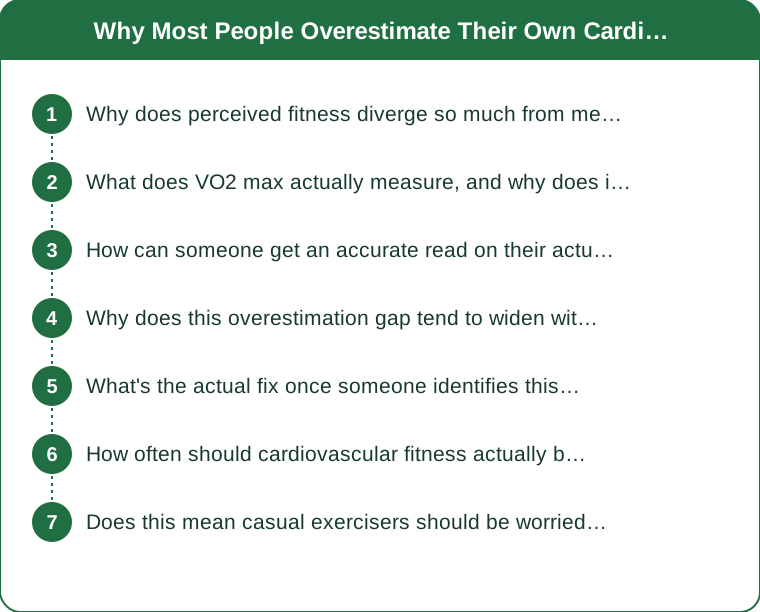
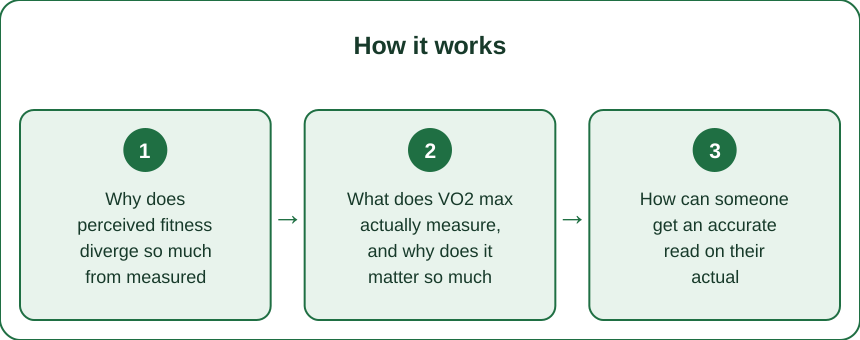
Why does perceived fitness diverge so much from measured fitness?
Daily life rarely demands anywhere near maximal cardiovascular output — walking, light chores, and casual exercise all sit comfortably within a range that feels effortless regardless of your actual aerobic ceiling. Someone with genuinely low VO2 max and someone with moderately good VO2 max can both feel equally ‘fine’ doing the same easy daily activities, because neither is anywhere close to testing their real capacity. The gap only becomes visible under genuine cardiovascular stress — a hard hill, a flight of stairs at pace, a real fitness test — which most adults simply don’t encounter regularly enough to get an accurate read on where they stand.
What does VO2 max actually measure, and why does it matter so much for longevity specifically?
VO2 max measures the maximum rate your body can utilize oxygen during intense exercise — essentially, the ceiling of your cardiovascular and muscular system’s combined efficiency. Large longitudinal studies have repeatedly found VO2 max to be one of the strongest predictors of all-cause mortality risk available, in some analyses outperforming more commonly tracked markers like blood pressure or cholesterol as a predictor of long-term health outcomes. This isn’t a minor wellness metric — it’s a marker with genuine predictive weight for how long and how well someone is likely to live, which is exactly why the gap between perceived and actual fitness matters more here than for less consequential fitness measures.
How can someone get an accurate read on their actual cardiovascular fitness without lab equipment?
A few field-based estimates exist that don’t require a lab: a timed 1.5-mile run or walk test compared against age and sex norms, a Cooper test (maximum distance covered in 12 minutes), or increasingly, wearable devices that estimate VO2 max from heart rate response during sustained effort. None of these match true laboratory gas-exchange testing for precision, but all of them are dramatically more accurate than subjective self-assessment, and any one of them is worth doing at least once as a genuine baseline rather than relying on how fit daily life makes you feel.

Why does this overestimation gap tend to widen with age?
Cardiovascular fitness declines gradually with age if untrained, roughly 1% per year on average starting in the 30s, but daily activity demands typically decline in parallel — retirement, less physically demanding careers, and general lifestyle changes all reduce the intensity ceiling people encounter regularly. That parallel decline means the subjective ‘I feel fine’ signal can hold steady even as objective aerobic capacity quietly drops well below where someone assumes it sits, which is precisely the scenario where an accurate baseline test matters most for catching the gap before it becomes a larger health risk.
What’s the actual fix once someone identifies this gap?
Zone 2 cardio — sustained, conversational-pace aerobic exercise for 30-45 minutes several times weekly — is the most well-supported foundation for improving VO2 max over time without requiring high-intensity work that can be harder to sustain consistently. Adding one or two higher-intensity interval sessions weekly accelerates VO2 max improvement further for those ready for it, but the base of consistent, moderate aerobic volume is what most improvement studies show actually moves the needle over months, not a single hard workout.
How often should cardiovascular fitness actually be re-tested?
Every 3-6 months is a reasonable interval for most people using field tests — frequent enough to track real change and catch a declining trend early, infrequent enough that the test itself doesn’t become a source of unnecessary anxiety or overtraining risk. The goal of tracking is course-correction, not constant judgment.
Does this mean casual exercisers should be worried about their fitness level?
Not worried — informed. The point of closing the perception gap isn’t to create anxiety about an unmeasured number; it’s to replace a vague, unreliable self-assessment with an actual data point that can meaningfully inform training decisions, especially for anyone specifically interested in the longevity research connecting cardiovascular fitness to long-term health outcomes. Most people who test their fitness for the first time in years find the number genuinely useful information rather than a source of alarm, and the fix — consistent Zone 2 work — is accessible at any current fitness level.
TL;DR:
- People consistently overestimate cardiovascular fitness because daily life rarely tests true aerobic capacity
- VO2 max is one of the strongest predictors of long-term mortality risk among commonly available fitness markers
- Field tests (timed run, Cooper test, or wearable estimates) close the gap far better than subjective self-assessment
- The overestimation gap tends to widen with age as both fitness and daily demands decline in parallel
- Zone 2 cardio, 30-45 minutes several times weekly, is the best-supported foundation for improving the number once you have it
This is general information, not medical advice — but a baseline fitness test is one of the cheaper, more useful things most people never get around to doing until much later than they should have.
Keep Reading
This article is for general informational purposes only and is not medical advice. Always consult a qualified health professional for guidance specific to you.