Why VO2 Max Might Matter More Than Almost Any Other Longevity Marker You Track
Quick Answer: VO2 max — your body’s maximum oxygen utilization capacity during intense exercise — has shown a stronger association with all-cause mortality risk in large studies than many traditional risk factors, and unlike genetics or age, it’s one of the more directly trainable numbers on your longevity dashboard.
Most longevity conversations center on blood markers, sleep, and diet. VO2 max gets less attention than it deserves, given what the research actually shows about its predictive weight.

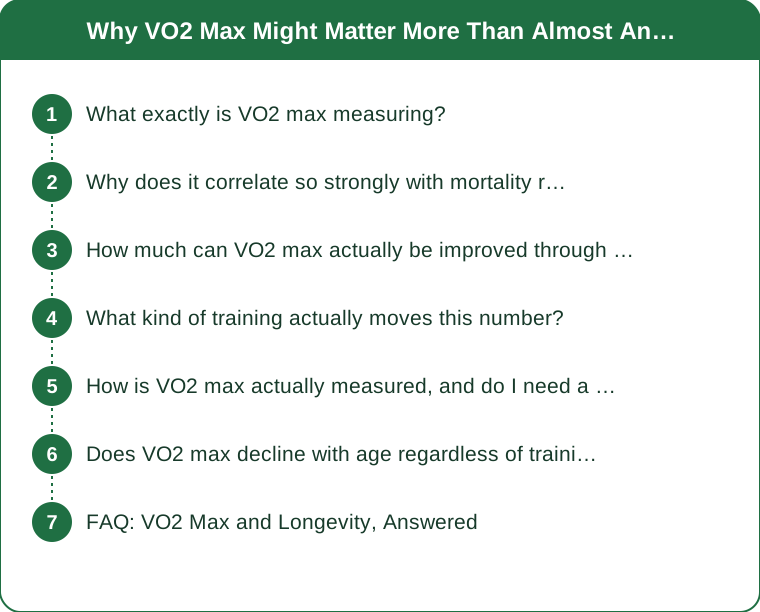
What exactly is VO2 max measuring?
VO2 max measures the maximum rate your body can take in, transport, and use oxygen during maximal exertion. It reflects the combined efficiency of your heart, lungs, blood, and muscles working together under real physical demand, not any single organ system in isolation.
Because it requires every part of that oxygen-delivery chain to function well simultaneously, it functions as a genuine whole-body capacity marker rather than a proxy for just one system.
Why does it correlate so strongly with mortality risk specifically?
Large population studies have found that low cardiorespiratory fitness, measured via VO2 max, predicts all-cause mortality risk more strongly than several traditional risk factors including smoking status and diabetes in some analyses. The proposed explanation is that VO2 max functions as an integrated readout of cardiovascular, respiratory, and muscular health simultaneously — a single number capturing multiple systems at once, which most individual biomarkers can’t do.
This doesn’t mean other risk factors don’t matter, but it explains why researchers increasingly treat fitness level as a vital sign worth tracking directly, not just as a side effect of exercising for other reasons.
How much can VO2 max actually be improved through training?
VO2 max has both a genetic ceiling and a trainable range, and most sedentary to moderately active people have meaningful room to improve within that range through structured training. Studies on interval training protocols specifically have shown measurable VO2 max improvements within 8-12 weeks in previously untrained or moderately trained individuals.
The improvement isn’t unlimited — genetics set an upper ceiling — but the practical takeaway is that for most people, current VO2 max reflects training history more than fixed biology, meaning it’s genuinely actionable rather than a number you’re simply stuck with.

What kind of training actually moves this number?
High-intensity interval training (HIIT) and sustained zone 2 (moderate, conversational-pace) cardio both improve VO2 max through different mechanisms — intervals push the ceiling of oxygen uptake capacity, while extended aerobic base work improves the efficiency of oxygen delivery and utilization at submaximal effort.
Most effective programs combine both: a weekly interval session or two alongside several longer, easier aerobic sessions, rather than relying on just one training style exclusively.
How is VO2 max actually measured, and do I need a lab?
Direct lab testing (a graded treadmill or bike test with a metabolic gas analyzer) is the gold standard, but it’s not accessible or necessary for most people to simply track improvement over time. Wearable devices (many modern smartwatches and fitness trackers) provide estimated VO2 max using heart rate and pace data, which, while less precise than lab testing, is reasonably useful for tracking your own directional trend over months.
For most people optimizing for longevity rather than competitive performance, tracking the trend direction on a consumer device is sufficient — you don’t need lab precision to know whether your training is moving the number up or down.
Does VO2 max decline with age regardless of training?
Yes, VO2 max does decline with age, roughly 1% per year on average after your 30s in untrained individuals, driven by natural declines in maximum heart rate and other physiological factors. However, the rate of decline is significantly slower in people who maintain regular cardiovascular training, and a 60-year-old who trains consistently can have a meaningfully higher VO2 max than a sedentary 30-year-old.
This reframes the goal for older adults specifically: it’s less about preventing decline entirely and more about slowing its rate and maintaining a higher relative fitness level than your age-matched sedentary peers.
FAQ: VO2 Max and Longevity, Answered
Is VO2 max more important than resistance training for longevity?
They’re complementary, not competing — VO2 max tracks cardiovascular capacity, while resistance training addresses muscle mass and bone density, both of which matter independently for long-term healthspan.
What’s considered a good VO2 max for my age?
Reference ranges vary by age and sex; being in the top 25% for your age-and-sex category is generally associated with the strongest longevity benefit in the research.
Can I improve VO2 max significantly after age 50?
Yes — studies show meaningful VO2 max improvements are achievable well into older age with consistent structured training, though the rate of improvement may be somewhat slower than in younger adults.
TL;DR:
- VO2 max measures your body’s maximum oxygen utilization and reflects several organ systems at once
- It has shown stronger mortality risk associations than some traditional risk factors in large studies
- Most people have real, trainable room to improve it, especially if currently sedentary
- A mix of interval training and zone 2 cardio is the most evidence-backed way to move the number
- Decline with age is real but significantly slowed by consistent cardiovascular training
Keep Reading
This article is for general informational purposes only and is not medical advice. Always consult a qualified health professional for guidance specific to you.