Why VO2 Max Might Matter More Than Your Weight for How Long You Live
Quick Answer: Large longitudinal studies consistently rank cardiorespiratory fitness (measured as VO2 max) as one of the strongest, most modifiable predictors of all-cause mortality — in several analyses, a stronger predictor than BMI, blood pressure, or even smoking status. Raising VO2 max, even from a low baseline, correlates with meaningfully lower mortality risk.
Body weight gets almost all the attention in longevity conversations. But a growing body of large-cohort research points somewhere else entirely: how efficiently your heart and lungs deliver oxygen to working muscle. That number — VO2 max — keeps outperforming weight-based metrics as a predictor of how long, and how well, people live.

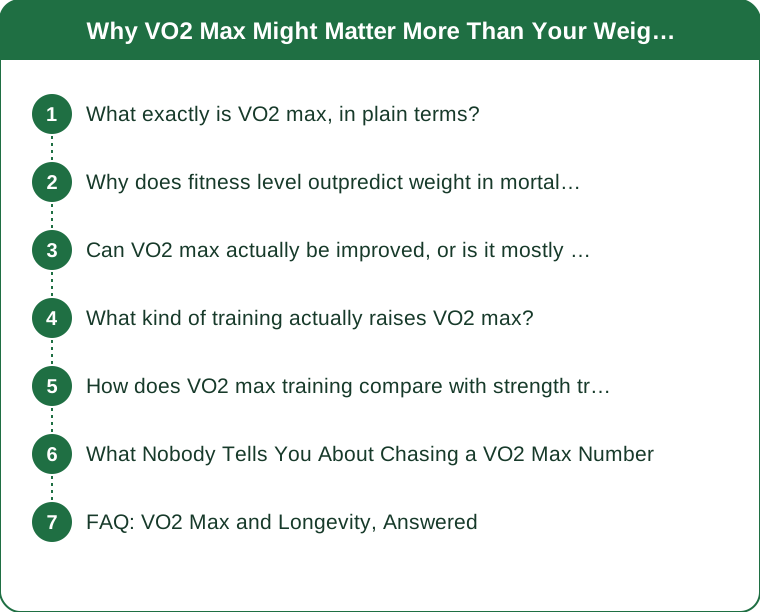
What exactly is VO2 max, in plain terms?
VO2 max is the maximum rate at which your body can take in, transport, and use oxygen during intense exercise, measured in milliliters of oxygen per kilogram of body weight per minute. It reflects the combined efficiency of your heart, lungs, blood, and muscles working together under real physical demand — which is why it captures something a scale or blood pressure cuff alone cannot: how your whole cardiovascular system performs under load, not just at rest.
Unlike a single static measurement, VO2 max is a dynamic capacity number. Two people at an identical weight and resting heart rate can have wildly different VO2 max scores, and in longevity research, it’s consistently the one of those two numbers that tracks more tightly with mortality risk over the following one to two decades.
Why does fitness level outpredict weight in mortality studies?
Several large cohort studies — including work following tens of thousands of adults through clinical exercise testing over 10-plus years — have found that cardiorespiratory fitness level predicts all-cause mortality more strongly than BMI category, and the effect holds even after adjusting for weight. In practical terms: an overweight person with high fitness consistently shows better long-term survival outcomes than a normal-weight person with low fitness, in study after study using this design.
The likely mechanism is that fitness is a marker of how well multiple organ systems are actually functioning together under stress — cardiac output, vascular flexibility, mitochondrial density in muscle, and metabolic efficiency all bundle into that one number. Weight alone can’t capture any of that; two people at the same BMI can have very different underlying cardiovascular function, and it’s that underlying function — not the number on the scale — that appears to matter most for lifespan.
Can VO2 max actually be improved, or is it mostly genetic?
Genetics do set part of the ceiling — twin studies suggest a meaningful heritable component — but the trainable portion is large and well documented. Structured interval training has repeatedly shown 10-20% VO2 max improvements over a matter of months in previously sedentary or moderately active adults, regardless of starting genetics. This is one of the more encouraging findings in the fitness-longevity literature: you don’t need elite genetics to move this number meaningfully, and even modest improvements from a low baseline correlate with outsized reductions in mortality risk in the data.
Importantly, the biggest survival benefit shows up when moving from the lowest fitness category to just the next one up — not from already-fit to elite. This means the person with the most to gain from starting a VO2 max training habit is precisely the person who currently has none.

What kind of training actually raises VO2 max?
The most consistently effective protocol in the research is structured high-intensity interval training: repeated efforts at 85-95% of max heart rate for 3-4 minutes, followed by equal or slightly shorter recovery periods, repeated 4-6 times per session, 2-3 times per week. Moderate steady-state cardio also raises VO2 max, but generally more slowly and to a smaller degree than interval work for the same time investment.
A well-known and heavily studied protocol is four rounds of 4 minutes at high intensity with 3 minutes of active recovery between — often called 4x4 training. Multiple trials have shown measurable VO2 max gains within 8-10 weeks using this structure, even in previously untrained middle-aged adults, which is notable since that’s exactly the population where longevity gains matter most.
How does VO2 max training compare with strength training for longevity?
The two aren’t competing — they’re addressing different mortality risk factors, and the strongest longevity research actually points toward combining both. Muscle mass and grip strength (proxies for resistance training’s benefit) predict different aspects of long-term health, particularly fall risk and metabolic function in later decades, while VO2 max more specifically predicts cardiovascular mortality risk.
A reasonable weekly structure that respects both bodies of evidence: 2 resistance sessions and 2 cardio sessions (at least one interval-style) is a commonly recommended split in longevity-focused programming, giving you exposure to both pathways rather than over-optimizing one at the expense of the other.
What Nobody Tells You About Chasing a VO2 Max Number
Here’s the part that rarely makes it into headlines: the absolute number matters less than the trend. A VO2 max of 35 that’s climbing from 28 over six months reflects a body adapting in exactly the direction associated with lower mortality risk — arguably more informative than a static 40 that hasn’t moved in years. Fitness trackers and wearables now estimate VO2 max reasonably well for tracking trend, even if not lab-precise, which makes at-home monitoring of this number more accessible than it’s ever been.
The other underdiscussed point: fitness testing labs and many wearables report VO2 max age-adjusted percentiles, and those percentiles shift the goalposts every decade. A 45-year-old scoring in the top quartile for their age bracket has done something different, physiologically, than staying at an absolute number — percentile trend by decade is arguably the more meaningful long-game metric to track.
FAQ: VO2 Max and Longevity, Answered
What’s considered a ‘good’ VO2 max for longevity purposes?
It’s highly age- and sex-dependent, but generally moving out of the bottom 20% for your age and sex bracket is where the largest mortality risk reduction shows up in the data — you don’t need elite-athlete numbers to capture most of the benefit.
How often should you retest your VO2 max?
Every 8-12 weeks is enough to see a meaningful trend from a structured training block; testing more often mostly captures noise rather than real adaptation.
Is it too late to improve VO2 max after 50 or 60?
No — multiple studies specifically in older adults, including some in their 70s, have shown measurable VO2 max improvements from structured interval training, and the relative mortality benefit from improving out of the lowest fitness bracket persists at those ages too.
TL;DR:
- VO2 max predicts all-cause mortality more strongly than BMI in multiple large cohort studies
- The biggest survival benefit comes from moving out of the lowest fitness bracket, not chasing elite numbers
- Interval training (like 4x4 protocols) is the most evidence-backed way to raise it
- Track the trend and your age-adjusted percentile, not just the absolute number
- Combine with resistance training — they address different longevity risk factors
This is general information, not medical advice — check with a doctor before starting high-intensity training if you have any underlying cardiovascular conditions. But the throughline in the research is clear: this is one of the most modifiable levers you have, at any age.
Keep Reading
This article is for general informational purposes only and is not medical advice. Always consult a qualified health professional for guidance specific to you.