Why VO2 Max Predicts Longevity Better Than Most Standard Blood Panels
Quick Answer: VO2 max — a measure of how efficiently your body uses oxygen during maximal effort — has repeatedly outperformed traditional risk factors like cholesterol and blood pressure in large-scale studies predicting all-cause mortality, largely because it reflects the combined function of your heart, lungs, blood, and muscles working together, rather than a single isolated marker. Most standard physicals never measure it directly, which means most people have no idea where they actually stand on arguably the single strongest fitness-related longevity predictor available.
You get your cholesterol checked every year like clockwork, but there’s a good chance nobody has ever measured the one cardiovascular number that predicts your long-term mortality risk more strongly than almost anything else on that panel.

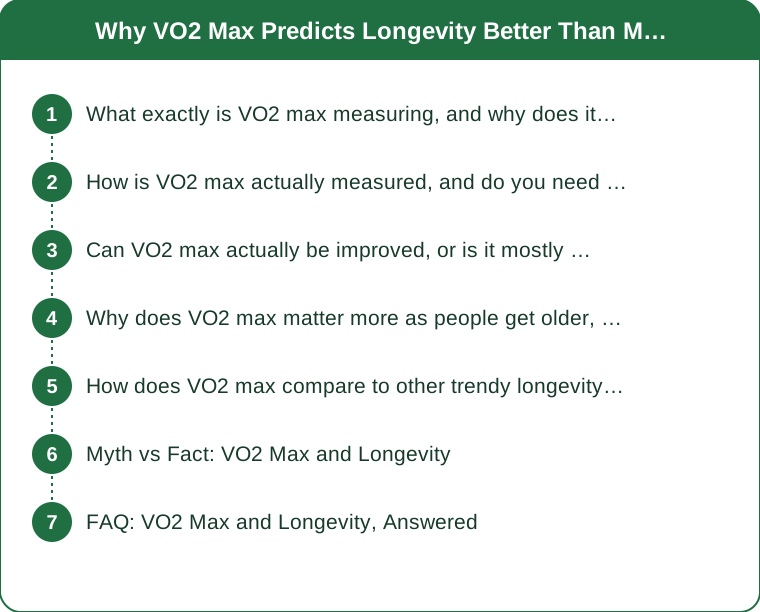
What exactly is VO2 max measuring, and why does it matter so much?
VO2 max measures the maximum rate at which your body can take in, transport, and use oxygen during intense exercise, and because that process depends on your heart’s pumping capacity, lung efficiency, blood oxygen-carrying capacity, and muscle mitochondrial density all working together, it functions as a kind of composite score for overall physiological resilience rather than a single-system measurement.
This is a meaningfully different kind of number than cholesterol or blood pressure, which each reflect one isolated system. A low VO2 max means multiple systems are underperforming together, which is part of why it correlates so strongly with broad health outcomes rather than one specific disease risk.
Research published in major cardiology journals has repeatedly found that VO2 max, when measured directly or estimated from exercise testing, predicts all-cause mortality more strongly than traditional risk factors measured in a standard physical, in some large cohort studies by a wide margin. This doesn’t mean cholesterol and blood pressure don’t matter — they clearly do — but it does mean VO2 max deserves far more attention than it typically gets.
How is VO2 max actually measured, and do you need a lab to find out?
The gold-standard measurement involves a lab-based test with a mask that directly measures oxygen consumption during a maximal treadmill or bike effort, which most people will never do outside of research or elite athletic settings. Fortunately, reasonably accurate estimates are now built into most modern fitness watches and smartwatches, using heart rate response during submaximal exercise combined with pace or power data.
These wearable estimates aren’t lab-precise, but they’re consistent enough over time to track meaningful trends — a rising or falling VO2 max estimate over months is informative even if the absolute number carries some margin of error. For most people, tracking the trend line matters more than nailing the exact figure.
If a more precise number is genuinely useful — for example, working with a coach on a structured training plan — a submaximal or maximal treadmill test at a sports performance lab or university exercise science department is widely available and doesn’t require elite athlete status to access.
Can VO2 max actually be improved, or is it mostly genetic?
Genetics set a real ceiling and a starting point, but VO2 max is meaningfully trainable at almost any age and fitness level, typically through a combination of easy aerobic volume (zone 2 training) and periodic higher-intensity intervals that specifically stress the upper end of oxygen delivery and use. Studies consistently show improvements of 10-20% or more over several months of structured training, even in previously sedentary older adults.
The encouraging part of the research is that this trainability doesn’t disappear with age the way some other fitness markers do — VO2 max responds to training stimulus well into older adulthood, which is part of why it’s specifically highlighted as a modifiable longevity lever rather than a fixed genetic hand you’re dealt.
This also means a low current VO2 max isn’t a permanent verdict — it’s a starting measurement that responds predictably to consistent aerobic training, which is a meaningfully more actionable message than most genetic risk factors offer.

Why does VO2 max matter more as people get older, not less?
Aerobic capacity naturally declines with age, but the rate of that decline is strongly influenced by training status, and the gap between a trained and untrained VO2 max widens significantly in older adulthood, precisely when the functional consequences of low aerobic capacity — reduced independence, higher fall risk, greater frailty — become most consequential. A higher VO2 max in your 60s and beyond correlates with meaningfully better odds of maintaining independent function.
This is part of why some longevity researchers specifically emphasize maintaining VO2 max training into older age rather than assuming lower-intensity movement alone is sufficient. The higher-intensity component genuinely appears to matter for preserving this specific metric, more so than gentle activity alone.
This doesn’t mean older adults should jump straight into intense intervals without a base — it means a well-structured program that includes some higher-intensity work, built up gradually, has a stronger evidence basis for preserving aerobic capacity than low-intensity movement alone.
How does VO2 max compare to other trendy longevity metrics like grip strength?
VO2 max and grip strength both predict mortality independently, but they measure genuinely different physiological systems — grip strength is largely a proxy for overall muscular strength and neuromuscular function, while VO2 max reflects cardiorespiratory capacity specifically. The research doesn’t suggest one replaces the other; if anything, having both consistently low is a stronger combined signal than either alone.
This is a useful reframe for anyone chasing a single ‘best’ longevity metric — the research increasingly points toward multiple complementary markers (VO2 max, grip strength, muscle mass, walking speed) together painting a more complete picture than any single number in isolation.
For someone starting from scratch, aerobic training tends to improve VO2 max specifically, while resistance training improves grip strength and muscle mass specifically — meaning a combined training approach addresses more of the longevity-relevant picture than either type of training alone.
Myth vs Fact: VO2 Max and Longevity
Myth: VO2 max is mostly relevant for athletes, not everyday health. Fact: The mortality-prediction research on VO2 max comes largely from general population cohorts, not athletes specifically — it’s a broadly relevant health marker, not a niche performance metric.
Myth: If your VO2 max is currently low, there’s not much point trying to improve it. Fact: VO2 max responds to training at essentially any starting point and any age, and even modest improvements are associated with meaningfully reduced mortality risk in the research.
Myth: A high resting heart rate always means low VO2 max. Fact: The two are correlated but not interchangeable — VO2 max is specifically about oxygen use at maximal effort, and resting heart rate alone doesn’t fully capture that.
FAQ: VO2 Max and Longevity, Answered
What’s considered a ‘good’ VO2 max for my age?
Good VO2 max benchmarks vary significantly by age and sex, with published normative tables available from exercise physiology sources — comparing your number against your specific age-and-sex bracket is more useful than a single universal target.
How often should I retest my VO2 max to track progress?
Most wearable estimates update continuously, but for meaningful trend-tracking, checking in monthly during a structured training block is a reasonable cadence without becoming obsessive about small daily fluctuations.
Is it ever too late to start improving VO2 max for longevity benefit?
Research on older adults, including those starting exercise programs in their 60s and 70s, consistently shows meaningful VO2 max improvements are still achievable — starting later still produces real, measurable benefit. This is general information, not medical advice.
TL;DR:
- VO2 max reflects combined heart, lung, blood, and muscle function, unlike single-marker blood panel tests
- Large cohort studies repeatedly show VO2 max out-predicting traditional risk factors for all-cause mortality
- It’s meaningfully trainable at nearly any age through aerobic volume plus periodic higher-intensity intervals
- It complements, rather than replaces, other longevity markers like grip strength and muscle mass
Most annual physicals will never put a number on your VO2 max, but given what the research shows about its predictive power, it may be worth more attention than the panel of numbers that do get checked every year.
Keep Reading
This article is for general informational purposes only and is not medical advice. Always consult a qualified health professional for guidance specific to you.