Why Your Walking Speed Says More Than Your Step Count
Quick Answer: Walking speed is one of the most consistently predictive everyday health markers researchers have found - large studies repeatedly associate brisk habitual pace with substantially longer life expectancy and lower cardiovascular risk, independent of total steps. The reason it predicts so well is that pace is a stealth systems test: it summarizes heart, lungs, muscle power, joints, balance, and nervous system in one number, in a way step counts cannot. The practical bar is a pace where conversation is possible but singing is not - roughly 100 or more steps per minute - held for at least part of every day’s walking.
Your watch congratulates you on steps. It stays diplomatically silent about the number that predicts more - how fast those steps were moving.

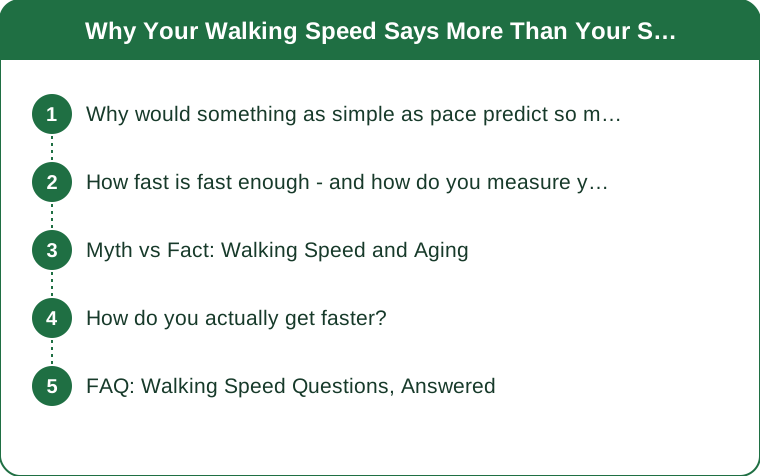
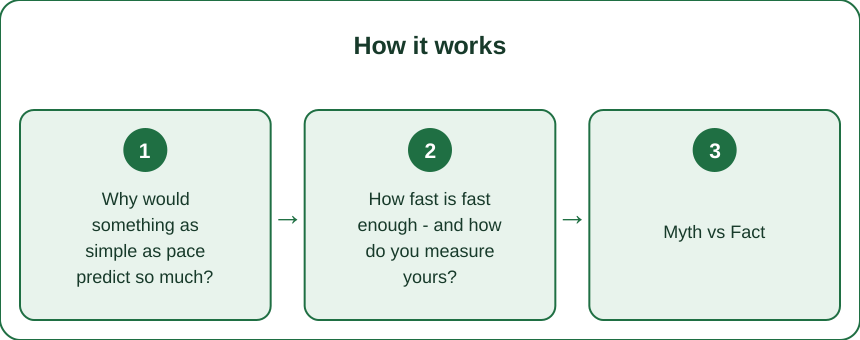
Why would something as simple as pace predict so much?
Because walking speed is not one ability - it is a composite score of most of the systems aging tests.
Pace is an integrated output. A brisk walk requires cardiac output, lung capacity, leg muscle power, joint range, balance, and motor coordination all functioning at once. Weakness in any subsystem drags the total down, which is exactly what makes the total informative - it is a whole-body audit disguised as a stroll.
The research signal is unusually consistent. Across large cohorts, self-reported and measured brisk walkers show markedly better long-term outcomes than slow walkers - differences in life expectancy estimated in years, not months, and the association holds after adjusting for weight and activity volume. Gait speed performs so reliably in older adults that clinicians use it as a functional vital sign.
Speed captures intensity, which counts capture nothing of. Ten thousand shuffled steps and ten thousand brisk ones register identically on a pedometer, but only the brisk ones meaningfully train the cardiovascular system. Pace is the intensity dimension the step number is missing.
Decline shows up in pace early. Habitual walking speed drifts down years before problems become obvious - which is why a slowing pace is worth noticing in yourself, not just in study populations.
The honest causal picture runs both ways. Fast walkers are partly fast because they are healthy, and partly healthy because walking fast is training. Both directions favor the same action: the pace you can hold is worth knowing, and worth nudging.
None of this demotes step counts - volume still matters. Pace is the second axis that turns a decent metric into a revealing one.
How fast is fast enough - and how do you measure yours?
The thresholds are friendlier than most people fear, and no lab is required.
The talk-sing test is the everyday gauge. Brisk means you can hold a conversation but could not sing a verse - breathing noticeably deepened, not gasping. This self-calibrates across fitness levels and ages better than any universal speed.
In numbers: roughly 100 steps per minute or about 3 miles per hour. That cadence marks the moderate-intensity line for most adults. Count your steps for 15 seconds mid-walk and multiply by four - over 100 and you are in the zone.
Try the timed 400 meters. A quarter mile - one standard track lap - at your natural brisk pace, timed twice a year. Around 6 minutes or under is a solid brisk benchmark; the trend across years matters far more than the number on any single day.
Phone and watch pace fields work fine. Your device already logs pace on walks - the useful habit is glancing at it and learning what your comfortable-brisk number is, then noticing drift.
Test on your terms. Pace varies with heat, hills, footwear, and fatigue - benchmark on a flat route in decent conditions, in actual walking shoes rather than sandals. Comfort gear is not decoration here: supportive sneakers and leggings with pockets that let your arms swing freely change a benchmark walk more than people expect, because a natural arm swing is part of a natural stride.
And interpret with context. A slower baseline with a stable trend is a different story from a fast baseline that has dropped 20 percent in a year - the second one is the conversation-with-your-doctor pattern, whatever the absolute speed.
This is general information, not medical advice - discuss significant unexplained changes with a professional.

Myth vs Fact: Walking Speed and Aging
Myth: Slowing down is just what aging is. Fact: Some drift is normal; most of the observed slowing is trainable loss - leg power and cardiovascular capacity that respond to exercise at every age. Studies that train older walkers reliably speed them up. The default is not destiny.
Myth: If I hit my step goal, pace is irrelevant. Fact: Volume and intensity are separate dials. Steps measure how much, pace measures how hard - and the health signal in the research tracks the second dial strongly. The best answer is the same steps with a brisk stretch inside them.
Myth: You need to power-walk everywhere, always. Fact: The evidence pattern rewards having briskness in your day, not living at maximum. Strolls with a friend, recovery ambles, and window-shopping pace all still count as movement - the target is that some daily walking hits the conversational-but-not-singable zone.
Myth: Walking speed is all about leg fitness. Fact: Pace also leans on balance, joint comfort, vision, and confidence - which is why it predicts so broadly, and why a sudden slowdown can flag things far from the legs, from anemia to fear of falling. Composite in, composite out.
Myth: A fitness tracker is required to use this. Fact: A 15-second step count, a timed lap, or the talk-sing check needs no electronics. The metric predates every gadget - clinicians measure it with a hallway and a stopwatch.
Myth: Speeding up my walk is too small to matter. Fact: Shifting habitual pace from slow to brisk is associated with some of the largest observational differences in the whole lifestyle literature - and unlike most interventions, it costs zero extra minutes. Same walk, more signal.
How do you actually get faster?
Walking speed responds to training like anything else - and the levers are specific.
Lever one: leg power. Fast walking is push-off strength. Two short weekly doses - sit-to-stands, step-ups, calf raises, each progressing over weeks - directly rebuild the power that habitual pace runs on. This is the highest-yield lever, especially past 50.
Lever two: deliberate brisk intervals. Inside your normal walk, alternate three minutes comfortable with three minutes brisk, four to six rounds. Interval-style walking has outperformed steady strolling for fitness and blood pressure in older adults in multiple studies - and it makes the brisk pace feel normal within weeks.
Lever three: cadence practice. Walk to music around 100 to 120 beats per minute and let the rhythm pull your step rate up - the painless way to raise pace without feeling like exercise.
Lever four: stride mechanics. Taller posture, eyes ahead, arms swinging from the shoulder, push through the back foot. Most people gain immediate pace from form alone - shuffling is a habit before it is a limitation.
Dress so the walk can be the workout it is. Breathable layers, actual walking shoes replaced before they collapse, and high-waisted leggings that stay put at pace - the brisk version of your walk deserves the same small logistics as a gym session, because it is quietly doing a gym session’s job.
And re-benchmark quarterly. The timed lap or a favorite route’s average pace, four times a year, written down. Watching your own number hold steady - or climb - across seasons is the entire feedback loop, and it is genuinely motivating in a way step streaks are not.
FAQ: Walking Speed Questions, Answered
What is a good walking speed for health?
For most adults, brisk means roughly 3 miles per hour or 100-plus steps per minute - the pace where talking works but singing would not. The personal version matters more than the universal one: know your comfortable-brisk number and watch its trend.
Does walking speed really predict longevity?
Large studies consistently associate brisk habitual pace with substantially better long-term outcomes, independent of total activity - it is one of the strongest simple markers in the literature. Part reflection of health, part cause of it; both parts reward the same habit.
Is a fast short walk better than a long slow one?
They do different jobs: the long slow walk delivers volume and recovery, the brisk stretch delivers cardiovascular training. The strongest pattern in the evidence is both - your normal walking with deliberate brisk intervals inside it.
How can I test my walking speed without a track?
Count steps for 15 seconds mid-walk and multiply by four - over 100 per minute is brisk. Or time a fixed neighborhood route quarterly and compare yourself to yourself. Phone pace fields work too; consistency of conditions matters more than the tool.
Should I worry if my pace has slowed?
Gradual small drift is common and trainable - leg power work and brisk intervals reverse much of it. A marked or fast slowdown, or one paired with breathlessness, pain, or balance trouble, is worth a medical conversation - pace is a vital sign, and vital signs that move deserve attention.
TL;DR:
- Walking speed is a whole-body composite - heart, lungs, muscle, balance - which is why it predicts so much more than step totals.
- Brisk means conversational-but-not-singable, roughly 100 steps per minute.
- Benchmark yourself quarterly with a timed lap or route; the trend is the message.
- Get faster with leg power work, brisk intervals, cadence music, and taller stride mechanics.
- Slow drift is trainable; sudden slowdowns are worth a doctor conversation.
The step counter tells you how much you walked. The clock tells you how alive the walking was - and that number, uniquely, is one you can train.
See It in Motion
Seen here: High Waist Yoga Leggings with Side Pockets — shop it on bubblelime.com
Keep Reading
This article is for general informational purposes only and is not medical advice. Always consult a qualified health professional for guidance specific to you.